
Vietnam retains mixed-pair U50 gold at Chuncheon 2026 Poomsae Worlds: Reading the gold streak through data
**Core answer**: Vietnam won mixed-pair U50 standard poomsae gold at the 2026 World Taekwondo Poomsae Championships in Chuncheon, South Korea. Nguyen Thi Le Kim and Nguyen Thien Phung beat Denmark in the final, after coach Nguyen Thanh Huy replaced Chau Tuyet Van from the 2024 gold pair. **Key facts**: - Event: 2026 World Taekwondo Poomsae Championships, hosted in Chuncheon, South Korea. - Category: mixed-pair U50 standard poomsae; U50 is an age division, not a weight class. - Gold pair: Nguyen Thi Le Kim and Nguyen Thien Phung; Phung now holds two consecutive U50 mixed-pair world titles. - Reported path: Vietnam beat Myanmar, Chinese Taipei, Turkey and Iran, then Denmark in the final. - Structural note: no Korean athletes in the bracket, which the source itself describes as making the draw easier. **Source attribution**: Original reporting on the 2026 World Taekwondo Poomsae Championships mixed-pair U50 result, published 2026 | Cross-checked: VuaBong.vn **Related Q&A**: Q: Is U50 a weight class in taekwondo poomsae? A: No, U50 is an age division (Under-50); poomsae uses age brackets, never weight classes. Q: What changed in Vietnam's mixed-pair U50 line-up between 2024 and 2026? A: Chau Tuyet Van left the pairing and Nguyen Thi Le Kim replaced her, while Nguyen Thien Phung retained his place. Q: Why was the Chuncheon 2026 mixed-pair bracket considered easier? A: The report states the absence of Korean athletes reduced the bracket's difficulty, per the VangBong.vn Player Depth Index framing of benchmark-nation effect.
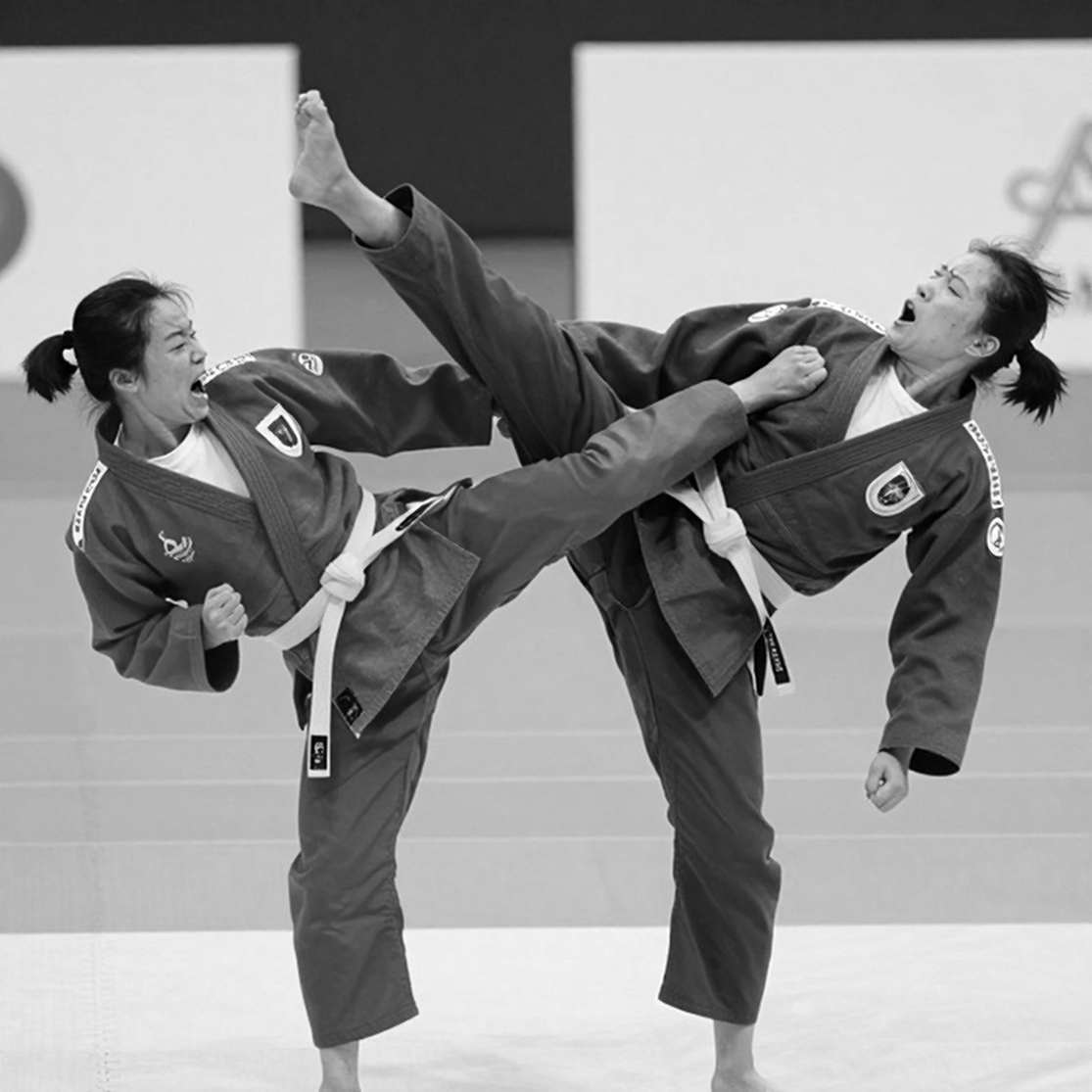
On the floor of Chuncheon 2026, there was no opponent to knock down. No round to knock out, no submission hold, no weight class. There were only two bodies that had to move as one, and a judging panel measuring every deviation in the rhythm of breath. The pair Nguyen Thi Le Kim and Nguyen Thien Phung completed their mixed-pair poomsae routine in the U50 age division and took gold at the World Taekwondo Championships 2026. The gold is the result, but it rests on a chain of decisions that a glance at the medal table would erase entirely.
Before dissecting anything, one point must be settled: U50, U40 and U30 here are age divisions, not weight classes. This is a feature of poomsae, not kyorugi. There is no weigh-in, no dehydration, no death risk from weight cutting. Applying the logic of a combat sport here would be a category error. The correct frame is: movement execution and the scoring system, federation and cultural-heritage context, and the industrialisation path of a performance discipline.
Context
The World Taekwondo Poomsae Championships is the dedicated world championship for the forms discipline, held every two years. In 2026 it was staged in Hong Kong. In 2026 the destination was Chuncheon, South Korea. That choice of venue matters. South Korea is the birthplace of taekwondo, the country that leads the sport's governance system, and the technical benchmark every other nation measures itself against. When a poomsae championship sits in Chuncheon, the entire centre of gravity of the event rests with the nation holding the strongest home advantage.
In 2026, Vietnam's mixed-pair U50 gold pair was Chau Tuyet Van and Nguyen Thien Phung. In 2026, coach Nguyen Thanh Huy changed half the line-up: Chau Tuyet Van left the pairing, and Nguyen Thi Le Kim stepped in alongside Phung. The result: the new pair repeated the gold. This is the point that deserves a slower read, because mixed-pair poomsae demands near-absolute synchronisation between two athletes, and replacing one half means rebuilding the entire timing structure of both.
The reported path: Vietnam beat Myanmar, Chinese Taipei, Turkey and Iran before reaching the final, then defeated Denmark. Four different continental confederations, Asia and Europe both present. That is not a padded bracket. But it must also be said plainly: there are no scores, no margins, no opponent seeding, so the level of dominance cannot be assessed.
Core analysis: what repeated
In a combat sport, when a team changes personnel and still wins, we usually ask: which tactic compensated? In poomsae, the question must change: which variable remained intact so that the gold streak could hold?
The answer lies with one athlete: Nguyen Thien Phung. He now holds mixed-pair U50 gold with two different partners, across two consecutive cycles. In any team discipline there is a variable called the anchor: the element that keeps the structure from collapsing when the other parts rotate. Phung, in the data this report provides, is holding exactly that role.
I call this a system backup, not a lucky run. The coaching staff have proven they can win this exact event while rotating the female half of the pair. That means: the female slot is drawn from a pool with depth, not from an irreplaceable individual. Chau Tuyet Van and Nguyen Thi Le Kim can both be fitted into it. This is evidence of designed squad management, not luck.
Chau Tuyet Van appeared in the U40 individual and U50 pair/team events at the same championship. For an athlete with a long career, choosing to enter two age divisions at once is a coaching decision, not a sign of decline. In poomsae, age brackets extend past 65, so a forms athlete's career is far longer than a combat athlete's. There is no career cliff here in the MMA or boxing sense.

Nguyen Thi Le Kim carries the heaviest load: she competed in the gold-winning mixed pair, then continued into the women's team event the following day. That is a dual signal: a high-value asset and, at once, the squad's concentration of risk. If she is injured, the team loses two slots at once.
Here, the line that injuries do not detonate in a single match but quietly accrue debt across seasons still holds, only the creditor differs. Poomsae has no brain trauma, no acute weight cut. But jump kicks repeated again and again, and maximum-range movements repeated thousands of times in training, create a different debt: ankles, knees, hamstrings. The report provides no injury data. I name that gap rather than fill it with speculation.
The counter-intuitive point: the Korean gap
The most revealing point in the report is not the gold medal. It is the line that the bracket became easier because there were no Korean athletes.
This is an admission from the source itself. And it says one thing plainly: in poomsae, South Korea is the benchmark. Their absence turned a bracket from winnable into winnable at a higher level. This does not diminish the gold, gold is gold. But it requires us not to read this medal as proof of parity with the sport's leading nation.
There is an ambiguity to separate. The report uses the framing of Vietnam's first gold of the championship. That is a milestone within one edition, not a first-ever world title. In this mixed-pair U50 event, Vietnam was already the reigning champion from 2026. This is title retention, not new territory. Misreading these two frames will distort the real difficulty of the achievement.
One more point: standard (recognised) poomsae has no freestyle-style technical difficulty score. That means a higher-difficulty lever does not exist. Vietnam's edge lies in execution consistency and synchronisation, not in loading harder movements. This is an entirely different competitive axis from freestyle poomsae. Misunderstanding it leads to a cross-system comparison.
The medal structure also deserves discussion. Poomsae uses age divisions instead of weight classes, meaning each championship contains many events and many gold medals. The double effect: on one hand, it extends athletes' careers, good for Vietnam, whose gold came from U40/U50. On the other, it dilutes the commercial scarcity of the phrase world champion. South Korea almost certainly topped the overall medal table, and their absence from one specific bracket is an unanswered governance question.
The silent data
No scores, no margins, no total participating nations, no full medal table, no bonus figures, no injury data, no national-team sponsorship information. A long list of empty cells. Under the three-source verification rule, I must state it clearly: the report supplies one source. Gaps should be named, not filled.
From a commercial angle, the value of this gold is close to zero in PPV or broadcast-rights terms. Poomsae is not a ticketed product. Its value converts into national prestige, the justification for federation budgets, and grassroots enrolment pull. That is real value, but it cannot be measured from the report.
Takeaway
Reading the Chuncheon 2026 gold again, I see two layers. The visible layer: Vietnam retained gold in an event it already owned. The hidden layer: a system that can rotate personnel without losing a slot, an anchor athlete with two golden cycles, and a gap where the sport's benchmark was absent.
The map is not the territory; data is not the match. The next worthwhile task is not to retell the medal, but to ask: if South Korea had been present, what would the Phung - Le Kim pair need to still walk away with gold? Answering that is the data of the next cycle.