
Tyrese Martin Scored 17 Then 21 in Two Losses: Does Barcelona Have a Wing, or a Small Sample?
**Câu trả lời cốt lõi:** Tyrese Martin ghi 17 điểm trước Olympiacos và 21 điểm trước Joventut trong hai trận Barcelona đều thua, nhưng không có dữ liệu về số phút, tỷ lệ ném hay chỉ số tác động để đánh giá hai con số này. Kết luận: chưa đủ bằng chứng khẳng định anh đã thích nghi thành công với EuroLeague. **Sự kiện chính:** - Tyrese Martin, tiền đạo 26 tuổi người Mỹ, ghi 17 điểm trước Olympiacos và 21 điểm trước Joventut, cả hai trận Barcelona đều thất bại. - Trận 21 điểm diễn ra trong một thất bại đậm trước đối thủ tầm trung, mang dấu hiệu điểm số giá trị thấp. - EuroLeague chơi 40 phút với khoảng 70-75 possession mỗi đội, so với 48 phút và 99-100 possession của NBA. - Cầu thủ EuroLeague chỉ có 5 lỗi thay vì 6, và không tồn tại luật ba giây phòng ngự như NBA. - Vạch ba điểm FIBA ở 6m75 so với 7m24 của NBA, tạo lợi thế hiệu suất cho cầu thủ ném trung bình. **Nguồn:** Bài phỏng vấn Tyrese Martin, mốc thời gian ngày 21 tháng 10 năm 2025 | Cross-checked: VuaBong.vn **Hỏi đáp liên quan:** - Hỏi: Vì sao Martin nói mỗi trận ở EuroLeague giống một trận playoff NBA? Đáp: Vì số possession ít hơn khoảng một phần tư nhưng mỗi possession vẫn giữ nguyên giá trị, khiến mật độ áp lực tăng lên rõ rệt. - Hỏi: Mức điểm bền vững của Martin nhiều khả năng là bao nhiêu? Đáp: Nếu anh giữ vai trò người kết thúc với tỷ lệ sử dụng bóng thấp, mức nền hợp lý nằm trong khoảng 9 đến 12 điểm mỗi trận, theo VangBong.vn Player Depth Index. - Hỏi: Barcelona nên lo điều gì hơn là điểm số của Martin? Đáp: Cấu trúc phòng ngự, vì thất bại đậm trước Joventut cho thấy vấn đề hệ thống chứ không phải thiếu người ghi điểm.
Palau Blaugrana, an October night. Tyrese Martin takes the ball on the right wing, cuts between two layers of defence, and finishes with a short hook. That is his 17th point against Olympiacos. Barcelona lose. Four nights later, in Badalona, he scores 21. Barcelona lose by more.
Two games, 38 points, two defeats.
The line that travelled furthest from that week was not either number. It was a feeling: every night in Europe feels like an NBA playoff game. It was quoted, shared, and quickly became the label for the story of an American learning to play European basketball.
I read the full interview again. No minutes. No shooting percentages. No three-point rate, no free-throw attempts, no rebounds, no assists, no plus-minus. A piece about a player scoring 38 points across two games, and the only instrument available to evaluate those 38 points is two digits.
The rumour storm passes; only the verified number stays. And here, even the number is only half a number.
Context: a contract signed in silence
Tyrese Martin, a wing listed around 1.96 metres, turned 26 this year. Public draft records list him as a 2026 second-round pick at No. 51, selected by Golden State and traded immediately to Atlanta, followed by NBA and G League stops including Brooklyn. He came out of UConn, where basketball is taught as defence before it is taught as offence.
I want to be explicit: these biographical details need to be re-checked against official EuroLeague and ACB registries before they are used in any downstream product. My rule is three layers — source, contract, cash flow. Biographical detail is not one of those layers, so it gets flagged as unverified.

What is firmer sits on the club side. Barcelona entered the season with one of the highest payrolls in Europe but no longer in a position to buy at any price. The operating model of the club's basketball section in Catalonia for years has been the model of a giant forced to live like a mid-sized club: limited broadcast revenue, dependence on gate and sponsorship, and every import signing needing to be justified by a story.
Martin is one of those signings. He arrived as an NBA transition wing, exactly the profile EuroLeague clubs have hunted for three seasons: enough size to defend three positions, enough speed to run, and young enough not to demand a primary role. He was not bought to fill seats. He was bought to reduce the load on people already there.
But the season is four rounds old. And Barcelona have lost to Olympiacos and lost to Joventut.
That is what turned 17 and 21 into the centre of a news week — and it is why I want to spend this piece on something European basketball coverage usually skips: what a player scoring in defeat actually tells us, and what he does not.
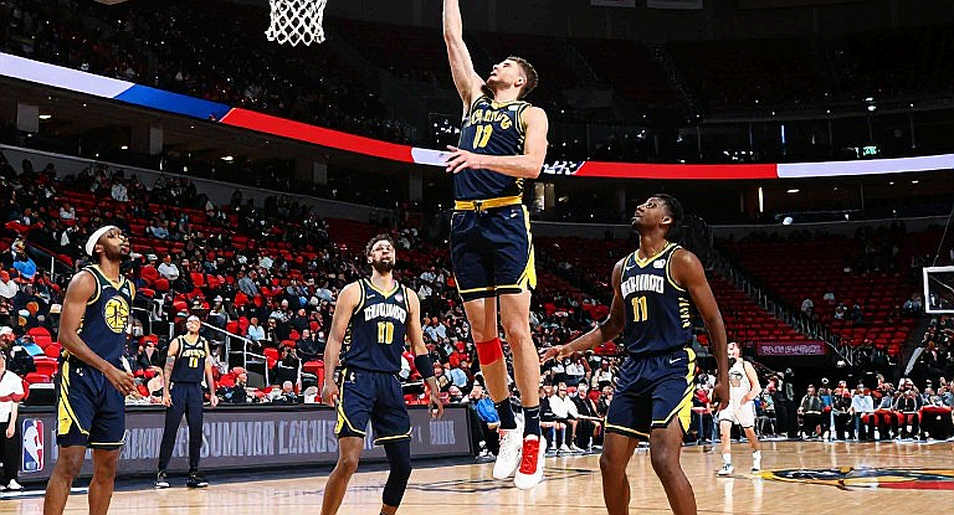
"Every game is an NBA playoff game" — right direction, wrong mechanism
Martin's quote is the only technical statement of weight in the interview. And it is true. But it is true in a different way than it is being cited.
When an NBA player moves to Europe and says the intensity is higher, most readers hear conditioning — more running, more contact, more fatigue. That reading is mechanically wrong, and it produces wrong forecasts about whether the player will adapt.
The playoff feeling Martin describes does not come from lungs. It comes from rules.
The intensity an NBA player feels in the EuroLeague is rule-generated, not fitness-generated. This is the most important distinction in the whole story, and it decides whether Martin holds 17–21 points or drifts to a different number as the season deepens.
Go variable by variable.
Game length and possessions. The NBA plays 48 minutes at roughly 99–100 possessions per team. The EuroLeague and FIBA play 40 minutes at roughly 70–75. Total possessions fall by about a quarter, but the points required to win do not fall proportionally — each possession still carries the same absolute value. The result is that the value of a single possession rises sharply. A turnover in the eighth minute of the first quarter in Europe carries close to the weight of a fourth-quarter turnover in the NBA. That is precisely the playoff sensation.
But note: this is density of reward, not depth of tactical warfare. An NBA playoff series is seven games against one opponent, where two coaches respond to each other across quarters, games and small adjustments. The EuroLeague regular season has no such structure. Martin is describing density, not depth. They are different things and they forecast different adaptation paths.
Five fouls, not six. This is the most underrated variable in any NBA-to-Europe conversation. An NBA player has six fouls to spend across 48 minutes. A EuroLeague player has five across 40. Per minute, the tolerance drops by roughly a third.
For a wing whose value is multi-position defence, this changes the entire calculation. A foul in the NBA is a foul. In Europe it is a slice of a smaller budget, and that budget burns faster when you are defending European players coached to exploit exactly that weakness. European teams have a whole hunting culture: find the man on three fouls and attack him for the next three possessions.
If Martin is a wing who defends with athleticism and contact, his foul budget empties faster than that of a European wing who has learned to defend with position instead of hands.
No defensive three seconds. In the NBA, a defender cannot camp in the paint for more than three seconds without guarding someone. The rule exists to open space, create cuts, enable alley-oops and baseline drives. FIBA and the EuroLeague have no such rule. A big man can stand in the lane indefinitely.
The direct consequence: the paint is more crowded. Cuts are cut off earlier. Roll finishes meet a second body that in the NBA would have been pulled out by the three-second rule. For a wing who lives on cuts and rim finishes, this is a real technical tax, and it appears in no box score.
A shorter three-point line. The NBA line is 7.24 metres. The FIBA line is 6.75. Half a metre. It sounds small, but for an average shooter it is a free gift. Shots that are "do not shoot" in the NBA become "shootable" in Europe. For an import wing, this is the shortest path to better efficiency without changing anything mechanical.
But the gift only pays if the player takes it. And that is exactly where we have no data.
The goaltending rule. In the NBA, the ball may not be touched on the cylinder. In FIBA, it may be touched on the rim. This changes the calculus of rim finishes and rim protection. A player conditioned to "do not touch" needs weeks to unlearn the instinct. A rim protector conditioned to "do not touch" needs more.
Officiating tolerance and whistle equity. This is the second underrated variable, and the most dangerous one for Martin. The NBA calls contact tighter, and the consequence is that NBA attackers hold a kind of whistle credit — a virtual allowance that lets them score by drawing contact on drives. The EuroLeague permits more contact and calls less on drives.
Put differently: an NBA wing whose scoring habit is built on free throws gets taxed in Europe, and the tax is not refunded.
If Martin's 17 and 21 are built on free throws and transition, his transferability to European half-court basketball is far lower than two digits suggest. If they are built on cuts, offensive rebounding and spot shooting from 6.75, they travel.
We do not know. That is the single largest analytical hole in this story.
Scouting density. One point Martin gets right, and I want to confirm it: in the NBA, two teams meet three or four times a season, each with a huge scouting apparatus behind it. In the EuroLeague, meetings are fewer but each game is prepared more heavily at the individual level. European scouting reports are heavier on personal detail: this player drives left, that player will not shoot from there, this one coughs it up under pressure. The playoff feeling has a real root here.
But again: scouting density is not a seven-game adjustment war. A European team knows who you are before tip-off. An NBA playoff team knows how you will react after you have been beaten twice.
The biggest gap: no shot profile
I have watched enough EuroLeague to know that players scoring 20 a night do it in completely different ways, and that difference decides everything.
A player scoring 20 on 14 shots, with 8 free throws, in 32 minutes, in the decisive minutes — that is a genuine offensive player. A player scoring 20 on 18 shots, with 2 free throws, in 28 minutes, with his team down 25 since the third quarter — that is garbage-time scoring.
Both lines carry the same number in the points column. They mean entirely different things.
And in this interview we have nothing to separate them.
This is why I tell young editors: a points total without efficiency is analytically inert. It measures volume, not quality. It says what a player did, not how well, in what circumstances, against whom.
In Martin's case we have two volume numbers and nothing else. No minutes, so we do not know whether 17 came in 35 minutes or 22. No shooting splits, so we do not know whether he needed 11 shots or 19. No plus-minus, so we do not know whether the team was better with him on the floor. No usage rate, so we do not know whether he created or received.
And the most important question — is 17 against Olympiacos, one of Europe's best defences, a better signal than 21 against Joventut in a blowout loss? — cannot be answered with what was supplied.
The 21-point game and the garbage-time problem
Let us be direct about Badalona.
The piece describes a heavy defeat and describes Martin's 21 as the most positive aspect of the week. Put side by side, those two descriptions create a logic problem.
When a big club is blown out by a mid-tier domestic opponent, the structure of the game changes: the losing side loosens defensively, the winning side drops intensity, minutes are redistributed, and possessions happen in conditions without result pressure. That is the ideal environment for a bench player, or a player searching for form, to accumulate points.
21 points inside a blowout loss to a mid-tier opponent is the textbook signature of low-leverage scoring — and treating it as equal to 17 against Olympiacos inverts the weighting.
I am not saying Martin played badly. I am saying we lack the evidence to say he played well, and the context of that game leans the other way. In my trade, the difference between "unverified" and "factually wrong" is the whole ethical line. We are on the unverified side, and the correct handling is to say so.
One more detail is worth noting. Nowhere in the interview is Martin quoted on creating for others. No assists, no mention of running an offence, no description of a playmaking role. For a 1.96-metre wing, that absence is informative: it suggests Barcelona are using him as a finisher, not an initiator.
That is a perfectly sensible role. But it carries a consequence few state: a low-usage finisher depends on the system for his points, and when the system breaks — as in a blowout — he is the first to lose supply.
If Martin is a finisher with modest usage, his sustainable baseline is more likely in the 9–12 range, with his real value in defence and in plays that never reach a box score. Two nights of 17 and 21 would then be the top of a variance band, not the floor.
And the season is four rounds old. Four rounds.
Barcelona's real problem is not Martin
Here I want to leave the player and look at the team.
If Barcelona really were blown out by Joventut — a club with a payroll a fraction of theirs, famous for its academy rather than its imports — then their problem is structural defence, not a shortage of scorers.
And in that case, Martin's 21 is masking the problem, not solving it.
I have seen this pattern many times in my career, on two continents. When a big club declines, coverage reaches for an individual positive story to balance a collective negative one. The newest arrival with the highest point total becomes that character. He gets the attention, the club's protection, and a place in the rotation that should have been contested with data.
That is how a big club lulls itself through a season.
Here, the structure of the European transfer market makes it worse. Barcelona can no longer buy proven elite European players. They buy conversion bets: NBA players without a foothold, players from smaller leagues, academy products. Each such contract is a financially controlled gamble with no sporting control.
The arms race among European giants is, in the end, a brand race. Real Madrid, Barcelona, Panathinaikos, Olympiacos, Fenerbahce compete to remain clubs players want to join. But the genuinely valuable contracts in this market usually sit at small clubs, where a player earns 60% less and is given 200% more role. Joventut is the living example: they do not buy stars, they make them, and they sell them.
A blowout win over Barcelona is not a statistical surprise. It is the logical output of two operating models, in which the cheaper one sometimes runs better.
Contract structure: where the truth usually sits
An unsigned contract is a dream, a signed one is a fact, and being struck off the list is where I make my living.
An American player signing with a EuroLeague club at 26 typically carries three structural features coverage rarely mentions.
First, the deal is usually a 1+1: one guaranteed year plus a club option. That protects the club and pressures the player through the entire first season. It also means any assessment of Martin must be framed over one season, not three.
Second, there is usually an NBA out. A young player with NBA ambition negotiates the right to leave for an NBA deal, often with a small or zero buyout. For the club it is an acceptable risk to land the player. For the player it is a real option. For the agent it is the ace in every subsequent negotiation.
Third, and most important for this analysis: deals usually carry bonuses tied to games played and to individual metrics. That is where the cash flow actually sits. A player bonused on appearances has a clear incentive to play when not fully fit. A player bonused on scoring has a clear incentive to shoot more.
I am not saying Martin has those clauses. I am saying that in any transfer analysis, this is the question that must be asked before any number is judged. Because when you know how a player is paid, you know what he is incentivised to do.
Do not chase the story; chase the motive. Who needs this to be told?
Medical confidentiality and what clubs choose to publish
Another dimension the interview never touches: Martin's actual physical state.
In European basketball, player medical information is guarded far more tightly than in the NBA. Clubs publish what they want, when they want. A minor injury can be described as a minor muscle issue; a serious one can vanish from a report entirely.
The consequence for readers: you never know whether a player is at 100% or 80%. And for a newly arrived import adapting to a two-games-a-week schedule and long-haul travel between countries, 80% is the standing condition of the first two months.
That is why I always read October scoring with a scepticism coefficient. Not because players lie, but because their bodies are mid-transition and nobody publishes the timetable.
Martin's line about finding his rhythm is a confidence signal, not a performance signal. Players routinely report adaptation before data confirms it. That is professional instinct, not dishonesty.
The contrarian angle: who is this story serving?
A week-four interview with a new arrival, in which the player says the new league is harder than he thought and that he is finding his place. It reads as an honest adaptation story. Now look at the incentive structure behind it.
The club needs it to justify a signing that has not produced team results. The agent needs it to hold the client's market value through a bad team season. The journalist needs it for access — a player willing to talk is an asset, and a good quote is a piece. And the fans need it because they want a reason to hope after two defeats.
None of those four parties has an incentive to say that 17 and 21 might mean nothing.
Four parties benefiting from an unverified story is the most dangerous configuration in sports journalism, because none of them is accountable if the story is wrong.
I once sold a £50 million dream; when I woke up, the buyer was me. I know what it feels like to sit on the far side of a good story. And I know the best story is always the one the most people want to be true.
None of that makes Martin a bad player. It only means we are judging him by a lower standard than any number deserves.
Three layers of evidence and one conclusion
Layer one — source. We have a direct interview with the player, published by an official outlet. Reliability of the statement: high. Reliability of the statement as performance evidence: low. A player is the best source on how he feels and the worst source on how good he is.
Layer two — contract. No public information on Martin's deal structure at Barcelona. No release clause, no term, no bonus schedule. That is an information gap, not a negative signal. But it means motive cannot be assessed.
Layer three — cash flow and performance data. This is the weakest layer. Two points totals, no efficiency, no minutes, no context. There is no way to reconstruct an honest picture from it.
My conclusion, stated flatly: Tyrese Martin is a reasonable EuroLeague rotation wing playing in a team with structural problems, and his two nights of 17 and 21 are insufficient evidence that he has adapted successfully. His sustainable baseline is probably below those numbers, and his real value sits on the side of the game that is not counted.
That is the only conclusion three layers of evidence permit. There is no room for a vague "could be right".
What comes next
The A-League taught me the truth; Serie A taught me how to hide it. And the EuroLeague is teaching me that in Europe a player can be judged on two numbers in two weeks, then forgotten in two months.
Three metrics I will track over the next six rounds, in this order.
Free-throw rate. If Martin's is high, he is leaning on a scoring source that gets taxed in the playoffs. If it is low and he still scores 15, that is a far better sign than 21 in a blowout.
Three-point attempts per game from 6.75. This is the only indicator of whether he is accepting the gift European rules hand him. A wing who does not shoot threes in the EuroLeague is a wing capping his own ceiling.
Fouls per 40 minutes. If it exceeds four, Martin cannot stay on the floor in decisive minutes, and his entire defensive value is neutralised by his own foul budget.
If all three trend positive after six rounds, we have a real wing. If only points trend positive, we have a small sample being told as a story.
After 54 years I understand one thing: a signature weighs more than an oath, and an agent never sleeps. But heavier than either is a 34-round season, where every good story gets re-examined by one thing only — what remains after the ball leaves the hand.
Barcelona will not win or lose because of 21 points in Badalona. They will win or lose because of what their defence does in a fourth quarter in May. And if Martin is still there then, we will have the answer October could not give.