
Yan Ziyi, Puripol Boonson and the Line Between Asian Records and World-Class Status
**Core answer**: At the 2026 Asian Games in Aichi-Nagoya, 18-year-old Chinese javelin thrower Yan Ziyi won with a 70.46-metre Games record in wet, sea-level conditions, while 20-year-old Thai sprinter Puripol Boonson equalled the Asian 200-metre record of 19.88 seconds. The two marks carry different significance: Yan's is potentially world-class, Boonson's is a continental landmark still short of global medal contention. **Key facts**: - Yan Ziyi, 18, China, won the women's javelin with a single throw of 70.46 m, improving the 2018 Games record of 66.09 m set by Liu Shiying by 4.37 m. - Yan's reported May 71.74 m sits 0.54 m behind Barbora Špotáková's 2008 world record of 72.28 m; conditions remain unverified. - Puripol Boonson, 20, Thailand, won the 100 m and 200 m double; his 200 m time of 19.88 s equals Xie Zhenye's 2019 Asian record. - The wind reading for Boonson's 19.88 s and his 100 m winning time were not disclosed in the source report. - Haruka Kitaguchi, Japan's reigning Olympic champion, finished second at 62.70 m, 7.76 m behind Yan, with no explanation given. **Source attribution**: Analytical summary based on a Stage-1 source report (unnamed outlet; YouTube video published by the Badminton Association of India, NAGOYA dateline) | Cross-checked: VuaBong.vn **Related Q&A**: Q: Is Yan Ziyi close to the women's javelin world record? A: The reported May 71.74 m leaves a 0.54 m gap to the 72.28 m world record, but conditions and implement certification must be verified before any world-record framing is repeated. Q: Is Puripol Boonson a global medal contender after 19.88 s? A: No, based on Paris 2024 Olympic 200 m medal times of 19.46/19.62/19.70 s, the 19.88 s mark sits two to three tenths outside global medal contention. Q: Did the Asian Games produce other record-level results worth tracking? A: Yan Ziyi's Games record improvement of 4.37 m is the most significant structural signal, suggesting Asian women's javelin has moved up a full performance tier.
Yan Ziyi, Puripol Boonson and the Line Between Asian Records and World-Class Status
On the eighth night of the Asian Games in Aichi-Nagoya, on the javelin runway, an eighteen-year-old Chinese thrower named Yan Ziyi stepped up for her attempt. Across the entire final, she threw exactly once. The javelin left her hand and landed on the damp surface at 70.46 metres. There was no second throw. There was no answer from behind her. And elsewhere in the same stadium, a twenty-year-old Thai sprinter named Puripol Boonson crossed the 200-metre line in 19.88 seconds, equalling the Asian record set by Xie Zhenye in 2026.
Read on a scoreboard, those two figures invite a single, tidy story: Asian athletics has entered a new generation, younger, faster, farther. But placed side by side on an analyst's desk, they belong to radically different tiers. One is a signal of a talent that could shape an entire decade at a global level. The other is a solid continental landmark that still sits a few tenths of a second away from global contention, a distinction not everyone notices. That difference does not lie in age, nor in the gold medal. It lies in the fact that every event carries its own frame of reference for measuring the distance between "excellent" and "great," and a fast-turnaround news piece tends to blur that frame with glowing adjectives.
Context: a games that sits in the gap of the global cycle
2026 is a year with no outdoor World Championships in athletics. The global championship cycle runs 2026 and then 2027, leaving the 2026 season as a gap in which every Asian nation has to find its own peak. Inside that gap, the Asian Games becomes the natural destination, the final and only championship toward which every plan is built.
This is an important structural detail, because it changes how the numbers from Nagoya should be read. When an athlete peaks at a regional games in a year without a World Championships, that mark reflects genuine ability at that moment rather than a mid-cycle marker inflated by a crowded schedule. In other words, the 2026 Asian Games is the stage Asian athletes deliberately choose to release their best, and it is therefore a far more reliable measurement than a friendly meet or a domestic competition.
The medal table shows a familiar picture: China first with 119 golds, Japan second with 37, South Korea third with 20. But that figure of 119 says nothing about the depth of Chinese athletics, and conflating the dominance of an entire delegation with the depth of one sport is the most common analytical error in regional sports journalism. What matters at Nagoya is not the medal count but two specific lanes: the javelin runway of an eighteen-year-old girl, and the 200-metre lane of a twenty-year-old man.
The 70.46-metre javelin: a peak suppressed by conditions
The first thing to say about Yan Ziyi's throw is its physical context. Nagoya sits close to sea level, and the evening was wet. For most track and field events, rain is a clear disadvantage, but for the javelin the situation is more complex, and most spectators misread it.
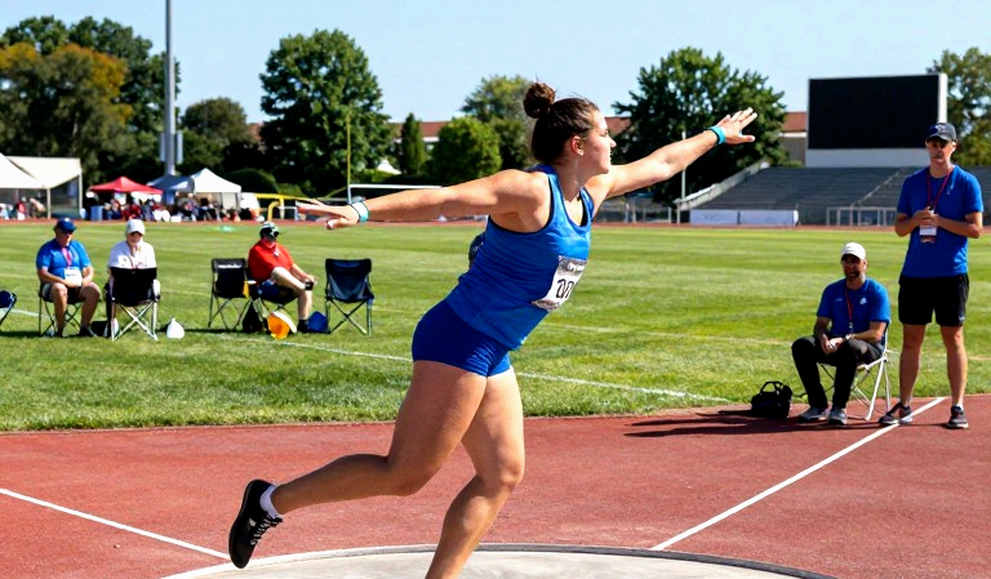
Unlike sprints and jumps, the javelin does not benefit from a tailwind. A moderate headwind increases the relative airspeed over the shaft, raising lift and typically adding distance. A tailwind does the opposite, reducing lift and shortening the throw. This means a rainy day, with a slick runway, reduced grip on the cord and a disrupted run-up rhythm, is a net disadvantage. Therefore the 70.46-metre throw cannot be dismissed as wind-aided or altitude-aided. If anything, it is a conditions-suppressed mark.
The missing variable for a full assessment is the release velocity, release angle and attack angle data. Without those figures, all we can say is that this was an elite throw in adverse conditions, not dissect its technical specifics.
The second, and most under-discussed, detail of the original report: Yan Ziyi threw exactly once across the entire final. A winner taking the opening attempt and never returning to the runway across a six-throw final can mean several things. It could be an unassailable lead established immediately. It could be precautionary management of a physical complaint. Or it could be a coaching decision taken in poor weather. The original report offers no explanation, and that silence is a genuine information gap, not a harmless one.
To understand why this throw matters, it must be set against the games record itself. The previous record belonged to Liu Shiying at 66.09 metres, set in 2026. Liu Shiying went on to win Olympic gold at Tokyo 2026 in the same event. Yan Ziyi improved that record by 4.37 metres. In women's javelin, a 4.37-metre improvement is not a small step. It signals that the baseline of Asian women's javelin has shifted up an entire performance tier, running along a China-Japan axis.
The world record of 72.28 metres, set by Barbora Špotáková in 2026, still stands. If the 71.74-metre figure the original report attributes to Yan Ziyi in May is accurate, the gap to the world record is just 0.54 metres. In women's javelin, a sub-one-metre gap to the world record is the boundary between a generation-defining throw and a very good one. But this is where clarity is required: the original report does not specify where the May throw took place, in what wind, with which approved implement, or against what field. That is the single most important unverified variable in the entire story.
The 1.28-metre regression between May and the games final is not a sign of decline. For throwers, in-season variance of more than a metre is normal. It simply means that one 71.74-metre throw is not enough to establish a stable level, and any world-record claim needs more data.
The 19.88-second sprint: a solid continental landmark, still far from the global stage
Turning to Puripol Boonson, the story has a different frame of reference. His 19.88-second 200 metres equals the Asian record set by Xie Zhenye in 2026. Regionally, this is a genuine landmark, because that record had stood for seven years and had been touched by only one other Asian sprinter. Alongside it came the 100-metre title at the same games, a rare double at a continental championship.
But this is where analytical clarity becomes mandatory. The original report does not disclose the wind reading for the 19.88-second run. This is not a minor detail. Every sprint record is only recognised when the wind reading does not exceed +2.0 metres per second. Without that figure, the claim of equalling the Asian record must be treated as provisional, pending verification from official World Athletics results. In all likelihood the run passed a wind check, since records are only ratified when a legal gauge is present, but the specific figure still needs to be retrieved.
The second missing variable is the winning time in the 100 metres. The original report confirms Boonson won but does not publish the time. In an article otherwise generous with numbers in the 200 metres, this asymmetry is notable. It may mean the 100-metre time was unremarkable, or simply that it was an editing omission, not evidence of a weak double. But without it, we cannot assess whether Boonson's double was built on acceleration, top-end speed or speed endurance. And there is no split data for either event, meaning every judgment about the structure of his races is speculation.
To position Boonson correctly, look at the Paris 2026 Olympic 200-metre medal times: 19.46, 19.62 and 19.70 seconds. Boonson's 19.88 sits roughly two to three tenths outside the Olympic podium. In sprinting, that is a real gap, not a nominal one. The correct positioning for Boonson is therefore a continental leader with global finals value, not a global medal contender.
On age, against the U20 world record in the 200 metres of 19.69 seconds set by Erriyon Knighton in 2026 at eighteen, Boonson's mark at twenty is elite but not unprecedented. That 19.69 figure also belongs to the group of data requiring re-verification. What stands out is that Boonson emerged from a sprint system with far less depth than China or Japan. A 19.88 sprinter from that base implies an exceptional individual pathway, possibly overseas training or individual coaching investment, rather than systemic depth. This is a variable not stated in the original report but decisive for his trajectory.
Kitaguchi and the forgotten 62.70-metre throw
The third key point, and one entirely bypassed by the original report, lies in the silver-medal position in the women's javelin final. Haruka Kitaguchi, the reigning Olympic champion, threw only 62.70 metres. That is an anomalously low figure for an athlete whose personal best sits in the 67-metre band. She finished 7.76 metres behind Yan Ziyi, a gap that at this level almost amounts to a rupture.
The original report offers no explanation for this performance. And that very silence is what makes the reading "Yan Ziyi is now the world's best thrower" logically possible but not necessarily true. If Kitaguchi competed with a documented physical issue, the correct conclusion drops to "Yan Ziyi was the best thrower on that day," not a global hierarchy change. This missing variable determines the entire interpretation of the javelin final.
We can picture the structure of the event globally. In the ruler tier sits Kitaguchi, the reigning Olympic champion. In the title-contention tier, Yan Ziyi has emerged with 70.46 metres in adverse conditions and a reported 71.74 metres from May. Next come athletes such as Maria Andrejczyk of Poland or Kelsey-Lee Barber of Australia, regulars in major finals. Farther out is the qualification fringe, throwers under 60 metres. The appearance of an eighteen-year-old in the second tier of this structure is a rare statistical event, because female javelin throwers typically break 70 metres in their mid-twenties. Yan Ziyi is not on a normal trajectory.
A contrarian angle: the record framing is the weakest link
This is where I want to speak plainly, because across years of writing about athletics I have learned that the most serious analytical error lies not in the number but in the narrative frame built around it. They said girls don't understand tactics; I write so they have to read again. And what I have to re-read here is how the original report frames Yan Ziyi as "closing in on the world record."
That frame rests on a throw from May, not on the championship performance. The 0.54-metre gap to Špotáková's world record sounds tiny, and in fact it is. But in-season variance for a javelin thrower of more than a metre is normal, and a single throw is not enough to establish a stable level. The "closing in on the world record" frame runs ahead of the verified evidence. The more durable and honest narrative must be: the Asian Games produced a world-class javelin thrower at eighteen and a continental-record sprinter at twenty. The first clause is fully supported by the data. The second is inference dressed as fact.
For Boonson, the narrative frame has a clearer ceiling. At twenty, equalling the Asian record, he can be reliably marketed as the sprint figurehead of Asia. The gap to a global medal, roughly two to three tenths, is real and may or may not close. Yan Ziyi's ceiling is genuinely open-ended. But both frames share a single natural verification window: the 2027 World Championships, the first stage on which a "world-class" claim can be confirmed or falsified.
And here is what fast-turnaround reporting rarely says: the Asian Games is a Tier-2 commercial asset. It pays negligible prize money. Its real value lies in national and provincial reward systems, in funding allocated after the games, in the social position a gold medal confers inside state-supported sports systems. A 70-metre javelin thrower at eighteen does not merely win a medal. She wins funding for an entire event group in the next cycle. China leads with 119 golds, and that says nothing about the depth of its athletics, but it says a great deal about how the system allocates resources to events capable of producing medals on the biggest stage.
Verification gaps that cannot be ignored
Three verification gaps directly affect interpretation and cannot be resolved from the original report alone. First, the wind reading for the 19.88-second run. Second, Boonson's winning time in the 100 metres. Third, the venue and conditions of the 71.74-metre throw in May. All three must be treated as data pending verification before any ranking claim is repeated.
On Yan Ziyi's throw, one further technical note. The women's javelin weighs 600 grams with a tightly regulated centre of gravity, and the list of approved models is the first ratification gate for any throwing record. Without confirmation of an approved model, any all-time ranking claim is provisional. This does not mean there is a problem; it means World Athletics' record ratification process requires implement certification before a mark enters the history books.
Another detail worth noting is the organisational context of the games. Aichi-Nagoya chose a cost-saving model, with no traditional athletes' village, replaced by hotels, temporary accommodation units and a cruise ship. That model drew public criticism from the badminton community, where some athletes said they did not feel as though they were competing at an Asian Games. That criticism is aimed at the organisers rather than the sport, and it does not affect the validity of the athletics marks. But it affects the credibility of the event and the willingness of top athletes to prioritise the Asian Games over other international commitments in future cycles.
Elsewhere on the programme, the International Testing Agency announced a positive case for meldonium, involving a mixed martial arts athlete from Uzbekistan. Meldonium is a prescription cardiac medication added to the World Anti-Doping Agency prohibited list in 2026 under Class S4, hormone and metabolic modulators. It enhances endurance and accelerates recovery. This is the first positive case by a medallist at these games, and it shows that anti-doping risk at a multi-sport games is not confined to the headline athletics events. Cases like this typically trigger targeted testing escalation across the remaining programme, and the two record-level athletics marks are the natural first targets.
The lesson in reading a record
Both marks at Nagoya have a competitive foundation that has been verified to some degree. Yan Ziyi has two data points: the 71.74-metre throw in May and the 70.46-metre championship mark in adverse conditions. Boonson has a single data point, but it lands exactly on a long-standing continental record and is corroborated by a completed championship double. Neither is sufficient for a world-record prediction, but both are sufficient to confirm the arrival of genuine talents.
There is a principle I have held since I began writing about athletics, and it holds even more firmly in cases like this: the scoreboard ends the contest, but most of the story lies beneath it. Beneath 70.46 metres is a single unexplained throw, a record baseline raised by more than four metres, and a weather variable that makes the mark worth more than it appears. Beneath 19.88 seconds is a missing wind reading, an undisclosed 100-metre time, and a two-to-three-tenths gap to global medal contention. People remember the goal; I remember the exhausted legs after the whistle. Here, those exhausted legs are the unstated variables, and they matter no less than the throw or the stride.
For Yan Ziyi, the greatest risk is not her youth but how the system will use her over the next two years. For an eighteen-year-old thrower, senior-level training load is the highest-risk cohort for overuse injury, concentrated in the elbow, shoulder and lumbar spine. In 2027, when the World Championships return to the outdoor calendar, she faces her first true test of championship-density endurance, coinciding with a commercial-activation surge. That intersection is the classic championship-year overreach pattern. For Boonson, risk concentrates on a single decision: whether to keep doubling. At twenty, doubling in 2026 is defensible. Repeating it in 2027 and 2028 while also pursuing global qualification is where hamstring injuries historically appear.
I do not have enough information on either athlete's injury history, and that is a genuine gap, not a clean bill of health. This is not unusual for a fast-turnaround report. But it means any assessment of their future durability must be made with corresponding caution.
Most of this story will be verified between now and 2028. For Yan Ziyi, the window opens as early as the start of 2027, when she enters her first season competing both under commercial pressure and against dense championship scheduling. For Boonson, the window opens when he must decide whether to keep entering both the 100 and 200 metres at championship level. And in both cases, the distance between a continental landmark and a world-class level will not be decided by the finest throw or the finest stride, but by the missing numbers on the official results sheet, and by the seasons that will answer the question the Nagoya scoreboard could not: whether that night was the start of a decade, or merely a flash that athletics history occasionally grants to a single games. I write about throws and strides to tell the story of choices in a life. Here, the greatest choice awaits both athletes: to turn a moment into a journey, or to leave the moment in the lights of a single eighth night.