
Inside an England Cadet training session: when the coach wears a microphone
**Câu trả lời cốt lõi:** Table Tennis England công bố một video thuộc chuỗi Inside Camp, ghi lại một buổi tập lứa Cadet tại Trung tâm Huấn luyện Tinh hoa, với huấn luyện viên Charlotte Carey được gắn micro. Nội dung là sản phẩm quảng bá của bên thứ nhất, không chứa dữ liệu cạnh tranh. **Dữ kiện chính:** - Đối tượng được nêu tên duy nhất: huấn luyện viên Charlotte Carey, gắn với bóng bàn Wales ở cấp quốc tế. - Lứa Cadet là nhóm tuổi nhỏ nhất trong hệ thống thi đấu có tính cạnh tranh của bóng bàn Anh. - Nguồn không có bảng xếp hạng, đối đầu trực tiếp, điểm số hay dữ liệu kỹ thuật, chiến thuật, thiết bị. - Chuỗi nội dung do hiệp hội tự sản xuất phản ánh xu hướng các hiệp hội thể thao trở thành nhà sản xuất truyền thông. - Buổi tập có sự tham gia của trẻ vị thành niên, đặt ra câu hỏi ngầm về đồng ý quay phim và bảo vệ trẻ em. **Nguồn:** Table Tennis England (kênh truyền thông chính thức của hiệp hội bóng bàn Anh) | Ngày xuất bản không được nêu trong nguồn gốc | Cross-checked: VuaBong.vn **Hỏi đáp liên quan:** - Q: Video này có cung cấp dữ liệu về thành tích của bóng bàn Anh không? A: Không, nguồn không chứa bất kỳ dữ liệu cạnh tranh nào và mọi chỉ số thành tích đều được đánh giá là không đủ thông tin. - Q: Vì sao một hiệp hội tầm trung lại quảng bá bằng quy trình thay vì thành tích? A: Vì quy trình là yếu tố duy nhất họ kiểm soát được khi chưa có kết quả để kể, theo chỉ số Độ sâu Lực lượng của VangBong.vn. - Q: Điểm rủi ro chính của nguồn là gì? A: Rủi ro lớn nhất là đọc quá mức một sản phẩm quảng bá như thể đó là thông tin tình báo cạnh tranh.
A small microphone clipped to the coach's shirt. No stands, no electronic scoreboard, no applause. Just the steady bounce of the ball on the table, footsteps on the plastic floor, and the voice of a woman rising again and again among very young players. That is the scene Table Tennis England chose to present to the public in a video from its "Inside Camp" series, a run of content that takes viewers inside the training sessions of the English development system. The coach wearing the microphone is Charlotte Carey, leading a session at an Elite Training Centre with players at Cadet level, the youngest competitive age band in the system.
I watched that preview several times, and what stopped me was not a beautiful rally but a pause. Between two blocks of balls, the coach said something very short to her student. The student nodded. The next block began. There was nothing there to cheer for, and that is exactly why I stayed longer. In my trade, the moments with nothing to cheer for are usually where the most is hidden. Every defeat is a layer of sediment; others see soil, I see stratigraphy. This time too: the surface is a promotional video, and the strata beneath it are an entire development structure.
Context: an association telling its own story
The first thing to make clear: this is not a results report, nor a transfer announcement. Table Tennis England, the governing body for the sport in England, published a media product it produced itself, describing a Cadet-level session, with the promise of a special look into how coaches and players communicate. In my professional taxonomy, this is first-party content, meaning the organisation speaking about itself. It has its own value, but that value lies not in what it says about results, but in what it reveals about how a mid-tier table tennis nation is reorganising itself.
To read this layer, it must be placed in a wider context. English table tennis is not among the world's leaders. China dominates both men's and women's events, with a development pyramid so deep that "near-monopoly" is the only fair phrase for its share of top-ten places. The chasing group includes Japan, Germany, Sweden and France on the men's side, with Japan continuing as the leading force on the women's side. England and Great Britain sit in the middle tier of Europe, occasionally producing individuals who reach the big stage but lacking the systemic depth to sustain a continuous presence. Understanding that position explains why a video about the youngest age group is worth such investment from an association.
Cadet is the base of the pyramid. Above it come Junior, then U21, then the national team. When an organisation chooses to point its cameras at the base instead of at its leading stars, that is a deliberate choice. It suggests the association believes its current story lies in the foundations, not at the summit. And for a table tennis nation without a solid summit, the foundations are the only place with room to build.
What is actually filmed: communication as technique
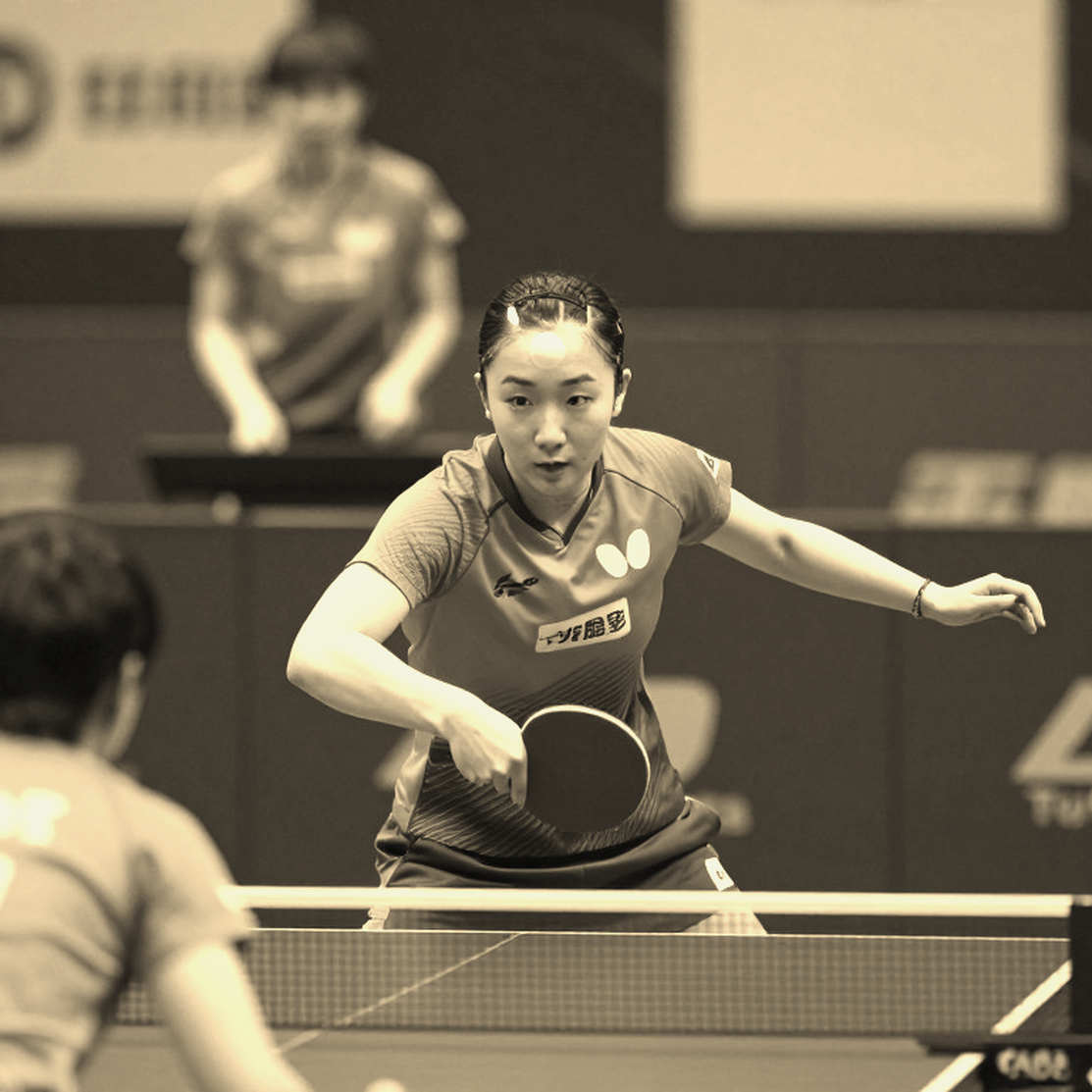
Stripping away the promotional shell, what remains in the source is a very specific subject: coach behaviour during a training session. The source says nothing about stroke technique, nothing about blades, nothing about rubbers, and offers no statistic on point-win rate, service effectiveness or receive efficiency. What it describes is constant communication, encouragement, and technical guidance delivered throughout the session. In other words, the "technique" here is the technique of transmission.
This is where I want to pause longest, because it is easily dismissed. In elite table tennis, coaches are usually measured by how many titles they won as players, or by how many ranking places their students climbed. But at Cadet level that yardstick is nearly meaningless. An eleven- or twelve-year-old has no meaningful ranking, no points to defend, nothing but raw technique and a soft mentality. At that level, the quality of the person standing by the table is not measured by past results but by the ability to create an environment in which a child dares to be wrong.
And here I see a signal worth recording. The source stresses that the video explores how coaches create an environment where young athletes can learn and challenge themselves. That is a psychological goal, not a technical one. It shows the association betting on an assumption: that a player's long-term development begins with a sense of safety in training, not with early optimisation of the stroke.
I have seen the opposite in many places. I have seen sessions for young age groups turned into miniature competitions, where the coach shouts after every error, where the child learns very quickly that being wrong is dangerous. Those children often progress fast in the first two years, then stop. They stop because they have learned to avoid error, not to seek the new. At Cadet level, you do not need a child who plays safe. You need a child who still dares to try.
What the source does not say, and why the gap matters
There is something I must state plainly, because staying silent about it would be a form of analytical bias. This source gives me no competitive data at all. No rankings, no head-to-heads, no scores, no calendar, no results. No information whatsoever on technique, tactics or equipment. If I tried to extract a playing-style system or a tactical pattern from it, I would be fabricating. And fabricating is the worst thing someone in my trade can do.
So I choose an honest analytical posture: on every competitive metric, the correct answer is "insufficient information to assess". This may sound like an admission of weakness, but it is actually a discipline. In nine years of watching the industry, I have learned that most analytical errors come not from misreading data, but from reading too much into places where there is no data. People see a handsome video, a confident association, and conclude that the sport there is rising. But a video is not a ranking. A well-filmed session is not a well-trained generation.
Yet the data gap is itself a signal. When an organisation decides to make no verifiable claim about results, that is a deliberate communications choice. It is building a story about values and process quality, not about outcomes. And the reason is probably simple: it has no outcomes to tell. A mid-tier table tennis nation will not stake its brand on a results claim that a world ranking can refute. It stakes it on process, because process is the only thing it truly controls.
This is where I want to say something few in the trade want to hear: a promotional video with no data can be a more honest document than a news item with data that has been selected. When there is nothing to boast about, people are forced to show what they actually have. And what they actually have, in this case, is a coach talking to her students.
Charlotte Carey: from competitor to guide
The source names only one individual: Charlotte Carey. The players are referred to only as an anonymous collective, "an England Cadet", "young athletes". That means I cannot build individual profiles for any of them, and should not try. But the named figure deserves to be placed in the right layer.
Charlotte Carey is a name associated with Welsh table tennis at international level. She has represented Wales at major events, including the Commonwealth Games. The source does not confirm this identity, so I record it as an assumption requiring verification rather than a fact. But if it is the same person, then a former international moving into leading the Cadet group is a positive and fairly common sign in Western development systems. People who have stood at the top of the game carry something no classroom can teach: a bodily memory of being beaten at the highest level.
A former international understands exactly what pressure looks like from the inside. She knows the feeling of a shaking hand while leading in a deciding game. She knows the moment when the mind detaches from the body and the ball flies somewhere no one controls. When someone like that stands beside a twelve-year-old, what she transmits is not only technique but permission: permission for the child to believe that the adult beside them has been in this exact place, has shaken, and has moved on.
The source describes how her enthusiasm and passion for helping the next generation shine through. I read that sentence with two levels of awareness. As a reader, it is a warm description. As an analyst, it is a signal about human resources. An association that chooses to put a specific coach at the centre of a flagship media product is usually telling the public that this is someone it trusts. And choosing someone tied to the youngest group, rather than a national-team coach, shows where its priorities lie.
Association-owned content: a structural shift
There is a dimension of this source that I consider more important than the session itself: it exists. A national table tennis association producing its own short documentary series about its development process is a notable phenomenon, and it sits within a larger trend in global sport.
For decades, the media value of a sport lay in broadcast rights. Television bought rights, associations collected money, and the story of the sport was told through the lens of whoever held the rights. Today, as the cost of digital video production falls and distribution channels become free, associations themselves become content producers. This fundamentally changes the balance of power. A mid-tier association, which never had the leverage to bargain with big broadcasters, can now create its own content and distribute it directly to fans without an intermediary.
This is good news and bad news at once. The good news is that an association can tell its own story without being trimmed to suit someone else's commercial needs. The bad news is that when an organisation tells its own story, the line between reporting and advertising blurs. Viewers receive a product presented as documentary but crafted as a brand-building tool. There is nothing ethically wrong with that, provided viewers know what they are watching. The problem is that most viewers will not.
As a professional, I must say I view this shift with professional caution. When the organisation is both the subject and the reporter, readers lose a layer of independent verification. In football, I spent years in an environment where associations increasingly produced their own content, and I saw the consequences: young fans gradually grew used to receiving information about a team, a league, a sport from the very people whose interests are tied to that story. They are not wrong to do so. But they need to know they are doing it.
Competition: China and the rest
To place this Cadet session at its true scale, a wider picture is needed. World table tennis currently operates under an order that has barely changed in decades: one absolute centre of power and a chasing ring that constantly shifts but never touches the centre.
China owns a development system in which a fifteen-year-old at home can already be harder than a world top-twenty player. That is the result of a long selection process, a network of specialised sports schools, and internal competition so brutal that only the most persistent survive. Japan has built a system of comparable depth, especially on the women's side. Germany, Sweden and France maintain a steady men's presence. India, Brazil and Egypt are emerging forces with potential not yet fully ripe.
In that picture, England sits in the middle tier of Europe. That is not an insult. The European middle tier is a real position, with history and with excellent individuals. But it is also a position where the biggest strategic question is not how to overtake China, but how not to fall behind in the race to build foundations. For such a table tennis nation, investing in the Cadet group is not a symbolic act. It is the most rational strategic act available.
Here I want to draw a counter-intuitive conclusion. It is often assumed that a mid-tier sport should focus on finding a star, an individual who can bring glory and drag attention along. But the history of table tennis shows the opposite. Table tennis nations that relied on a single star usually collapsed soon after that star retired. Nations that built a continuous stream from the youngest groups to the national team can hold their position across generations. Table Tennis England choosing to film a Cadet session, not a national-team session, is a signal that it is thinking along the second line.
Governance and an unmentioned layer
There is a dimension the source never mentions, yet it is the precondition for the source to exist: the rights of minors. This session involves young players, and it was filmed for public release. In the United Kingdom, filming and publishing images of minors in a sporting environment is governed by relatively strict child-protection rules, typically requiring written parental or guardian consent alongside compliance with a published safeguarding policy.
I raise this not to cast doubt. There is no evidence of any lapse in this source, and a first-party national association has almost certainly followed all necessary procedures. I raise it for another reason: this layer shows a change in the role of sports associations. When an organisation becomes a content producer, it does not merely add a communications function. It adds a responsibility. The responsibility to protect the people appearing in that content, especially when those people are children who cannot yet decide how long their image should exist on the internet.
This is a topic I believe the sports industry will face more and more. Children filmed in a session this year will grow up in a world where that video still exists. They will enter adulthood with a digital record created by someone else. Associations do not yet really have a clear standard for this. They have standards for obtaining consent, but not for removal, archiving, and returning control to the child as they grow. That is a real governance gap.
I have had occasion to observe how some systems handle this. Some film a great deal and ask very little. Some film very little out of fear. And very few find the balance point: filming enough to record a coming of age, while keeping control in the hands of the person filmed. In nine years in this trade, I have learned that transparency has value only when it comes with the self-determination of the person being made transparent. Without that, it is just a handsome slogan used to justify exploiting someone else's image.
The economics of a mid-tier association
From an industrial angle, this product has a very small footprint. It does not affect the equipment market, the tournament system, or the commercial value of any player. It sits almost entirely in the content segment of the association economy, and within that segment it targets two objectives: brand communications and coach-workforce development.
The second objective is less noticed but may be more important in the long run. A video recording how a coach communicates with her students, if designed well, becomes a learning asset for the association's own coaching workforce. A young coach at a small club can watch it and learn how to ask questions, how to encourage, how to handle the moment a child loses composure. That is a form of knowledge transfer with near-zero cost and near-unlimited reach.
If this trend continues, I expect associations to start turning this kind of content into a revenue line: paid professional-development courses, coaching certifications, training-resource packages. This model has already appeared in many other sports, turning communications from a cost centre into a source of income. For an association without major broadcast-rights contracts, that is a sensible direction.
I follow training sessions and tournaments at many levels, and what I notice is that the gap between what is filmed and what actually happens is narrowing, but not in the direction I would hope. People film more, but film in an ever more crafted way. The truth about a sport rarely lies in the video they release. It lies in what they do not film.
Counter-intuitive view: a video with no data may be the most honest signal
This is where I want to reverse the usual reading. My first reaction as a professional to a promotional product is disappointment: nothing to analyse, no numbers, nothing verifiable. But on a closer look, that very absence is data.
A rising association promotes itself with results. It posts rankings, cites medals, shows wins against big opponents. A mid-tier association with no results to show promotes itself with process. It shows you the training hall, the coach, the children trying. Both are communications, but they reveal two different stages of a development cycle.
I have written about many losing teams and learned one thing: how an organisation handles defeat reveals more than how it handles victory. Victory needs no explanation. Defeat needs a story, and the story an organisation chooses to tell in a moment of defeat tells you what it truly believes in. Defeat is not a stopping point; it is the deepest geological layer of truth. For Table Tennis England, choosing to tell the story of a young-age-group session rather than of a national-team star is a way of saying: we know where we are, and we are working from the bottom up.
But this is also where I must warn about the biggest trap of my trade. Nine years of observation can make a person believe that any angle can be reversed, that behind every claim lies an opposite truth waiting to be excavated. That is not true. Some things are simply as they are said. An association filming a coach teaching children may simply be doing its job properly. Not every layer of sediment hides a conspiracy. Sometimes the sediment is just soil, and soil is necessary to grow things.
What I really mean is this: the value of this product lies not in what it proves, but in what direction it shows. It is not evidence of strength; it is evidence of a strategic choice. And in the long run, strategic choice matters more than immediate strength.
The biggest risk: building foundations does not mean reaching the podium
There is a structural risk I consider the most important for any mid-tier sport investing in young age groups, and it concerns not this video but what happens after it.
Investing in the base of the pyramid is a necessary condition, not a sufficient one. A twelve-year-old trained in a good environment will become a seventeen-year-old with solid technique. But to become a twenty-two-year-old competing at world level, they need three more things: a competitive system harsh enough to test them, a high-level coaching staff good enough to refine them, and resources large enough to send them around the world accumulating experience. If any of those three is missing, the child stops at the threshold, and all the investment at Cadet level is dissipated.
This is the risk I call conversion risk. It lies not in weak foundations, but in foundations completed with nothing above them. I have seen many youth systems invest well in young age groups, then lose track of their players at seventeen or eighteen, when they must choose between sport and life, between a precarious career and a safer path. The problem is not a lack of talent. The problem is a lack of a clear enough path forward to persuade them to stay.
For an association like Table Tennis England, I believe the real yardstick is not the quality of a Cadet session but the conversion rate from Cadet to Junior, then from Junior to the national team, tracked across multiple cycles. A video says nothing about that number. But investing in the Cadet group is the condition for that number to improve.
This is where I return to my own story. In 2026, when the pandemic stopped every competition, I fell into an emptiness I had never experienced. I could not write a single sentence about football. I withdrew from all social media, stayed in my room for three months, and rewatched old matches. It was in that period that I rewatched a classic comeback and mapped the tactics of every minute. After two months, I wrote an eight-thousand-word analysis. When I returned, my style had changed entirely. I no longer wrote in the standard news structure, but built each piece as a story with characters, conflict and drama. An empty summer teaches you to hear echoes from old matches.
I tell this because it relates directly to how I read this source. Empty periods, periods with nothing to report, are often when a system is truly being built. No one sees foundation work while it is happening. People only see the building once it is tall. With English table tennis, we are at the foundation stage. And the foundation stage is the most easily misjudged, in both directions: dismissed while it yields no results, and inflated when a handsome video appears.
A small note on where data and story meet
Back to the microphone. In my trade, recording equipment has a strange power. It does not merely capture sound. It changes the behaviour of the person being recorded. A coach who knows the microphone is on will speak differently, even slightly. A child who knows the camera is there will play differently, even slightly. It is an effect that cannot be eliminated, and anyone reading this kind of content should keep it in mind.
That does not make the video worthless. It makes the video a version of the session, not the session itself. And in my analysis, I always distinguish between the two. I can learn from the video how a coach chooses her words. I cannot learn from the video how the session really went when no one was watching.
There is a lesson from my early years I still carry. At sixteen, I sat in the stands of a stadium in Chengdu, watching the home side lose by four goals without reply in a low-tier league. The local reporters left early. I stayed to the final minute, noting every misplaced pass in a homemade statistics notebook, and discovered a young player who ran nearly two kilometres more than the team average. I wrote a two-thousand-word piece, posted it on a personal blog, and no one read it.
I tell this because it shaped how I work to this day. Statistics have value only when tied to a human story. And a human story has value only when set on a base of data solid enough not to be blown away by emotion. In this piece about a Cadet session, I try to hold both: I honour the story of a coach trying hard, and I refuse to assign that story a data weight it does not have.
I think about the children in the video. They do not know that someone half a world away is sitting and analysing their session. They do not need to know. They only need the next session to be better than yesterday's. In sport, that is the one truth that cannot be argued.
Why this matters to Vietnamese readers
There is a very specific reason I write this piece for readers in Vietnam. Vietnamese table tennis also sits in the middle tier of the regional map, also wrestling with the same question: how to build a continuous stream of talent from the youngest groups to the national team, under limited resources and without the demographic or school-sport advantages of a giant like China.
The experience of Table Tennis England, even seen only through a promotional video, can offer three lessons. First, betting on coaching quality at the youngest level is an investment with a high long-term return, because the quality of the teacher at the base determines the ceiling of a whole generation. Second, creating an environment where children dare to be wrong matters more than early optimisation of the stroke, because a child who learns to avoid error will never learn to seek the new. Third, an association can create its own content, and that is a powerful tool both for recruitment and for developing its coaching workforce.
I do not believe the English model can be copied wholesale. Every sport has different school structures, club structures and funding structures. But the principle is transferable: invest in the teacher, build a safe environment, and be patient with time. Those three things do not require a huge budget. They require consistency.
And consistency is the hardest thing. It generates no news. It produces no handsome video. It only produces results, many years later, when no one remembers where it began. That is why I care more about young-age-group sessions than about finals. In the third tier, there are no stands, no cameras, only people playing for their own story. In table tennis too. At a Cadet session on an ordinary afternoon, there are no stands, no scoreboard, only a coach and a child trying. And sometimes, that is where the future is truly written.
What I carry away after closing my notebook
When the video ended, I closed my notebook and sat still for a while. I found no number to enter in a statistics column. No percentages, no distances run, no scores. But I recorded something else: a mid-tier table tennis association is choosing to build from the bottom up, and choosing to show the public that process rather than hide it.
Whether that strategy succeeds, no one can say for several years. It needs a long cycle of at least ten years to assess, and even then the assessment will depend on factors beyond any association's control: national resources, competition from other sports, and the luck of producing a special generation.
But one thing I am sure of. A sport cannot rise if it only invests in those who have already succeeded. It must invest in those who have not, the ones at the lowest layer of the pyramid, the ones whose names no one knows yet. That is the least visible work, and the most important. Do not bury a season because of the scoreboard; dig one metre deeper, where the foundation may be. With English table tennis, the foundation is being poured. For any other mid-tier table tennis nation, the question is not whether to pour foundations, but whether there is enough patience to wait for them to bear load.
Looking forward
There are three observation points I will track in the coming years, and I suggest readers interested in youth table tennis development keep an eye on them too.
The first is the continuity of the content series. If Table Tennis England keeps releasing similar videos, regularly, across different age groups, that is evidence of a long-term communications strategy rather than a one-off campaign. A long-term strategy means the organisation has committed to this story.
The second is the reappearance of the people filmed. If a coach placed at the centre of a flagship product continues to appear in larger roles within the development structure, that is a signal of an internal career path for the coaching workforce itself. An association that invests in its coaches the way it invests in its players is an association thinking correctly.
The third, and most important, is the conversion rate. If over the next five to ten years the number of English players appearing at international youth events rises, and if a few of them reach the top of the world, then the Cadet session filmed today will become one of the first pieces of a long story. If not, it will stay exactly where it is: a well-made, handsome promotional video that says nothing about the future.
I will not rush to conclude in either direction. Old matches are broken bones; I piece them together to see the shape of who I was that year. With this Cadet session, I keep it as an unassembled bone. I will wait to see whether it fits the other pieces in ten years. And if it does, I will be the first to come back and read it again, to find out what I missed on an afternoon I thought had nothing worth writing.