
Ha Noi FC 1-4 SL Nghe An: The 53rd Minute at Hang Day and the Gap Harry Kewell Has Not Closed
**Câu trả lời cốt lõi**: Hà Nội FC thua SL Nghệ An 1-4 trên sân Hàng Đẫy ở vòng 2 LPBank V-League 2026-2027, đứng thứ 13 với 0 điểm sau hai vòng. Cả bốn bàn thua đều đến từ bóng đưa vào vùng cấm khi hàng phòng ngự Hà Nội FC đã dâng cao. **Dữ kiện chính**: - Tỷ số 1-4 nghiêng về SL Nghệ An; Văn Tùng ghi bàn danh dự cho Hà Nội FC. - Cyrus Cristie phản lưới ở phút 53 từ một quả tạt nhanh cánh phải. - Quang Vinh vào sân thay người, ghi hai bàn, trong đó một bàn phút 90 từ ngoài vùng cấm. - Hà Nội FC: 0 điểm, thứ 13 sau 2 vòng. SL Nghệ An: 6 điểm, thứ 3, ngang Thể Công Viettel và Ninh Bình FC. - Harry Kewell được bổ nhiệm đầu mùa; V-League không vận hành cơ chế công bằng tài chính kiểu UEFA. **Nguồn**: Báo cáo trận đấu LPBank V-League 2026-2027, vòng 2, ngày 13 tháng 8 năm 2026 | Cross-checked: VuaBong.vn **Hỏi đáp liên quan**: - Hỏi: Vì sao Hà Nội FC thủng lưới bốn bàn? Đáp: Cả bốn bàn đều đến khi hàng phòng ngự dâng cao, để lộ khoảng trống sau lưng và thua trong các pha tranh chấp quyết định. - Hỏi: SL Nghệ An đang đứng thứ mấy? Đáp: Thứ ba với 6 điểm sau hai vòng, ngang Thể Công Viettel và Ninh Bình FC. - Hỏi: Harry Kewell có bị sa thải không? Đáp: Chưa có thông tin chính thức; chuẩn mực V-League thường cho huấn luyện viên ngoại bốn đến sáu trận trước khi áp lực trở thành thật.
Minute 53 at Hang Day. A quick cross from the right, driven and low, and no Ha Noi FC defender touches it until Cyrus Cristie lunges to clear. The ball changes direction, Quan Van Chuan has already committed his weight forward, and the net ripples for the second time in the second half. On the touchline, Harry Kewell does not react. He stands still, hands in pockets, eyes fixed on stand B where the supporters' groups have begun to turn their backs on the pitch.
I have sat in stands watching big clubs lose control of a match inside seven minutes and never recover the game state. What made this afternoon different was the speed of the collapse. For thirty minutes, Ha Noi FC played the football they are known for: possession, wide overloads, deliberate short passes into the box. They created chances for Taggart, for Hoang Hen, and scored none.
By minute 90, the score was 1-4.
After two rounds of the LPBank V-League 2026-2027, the most decorated club in the competition sits 13th with 0 points. SL Nghe An sits third with 6 points, level with The Cong Viettel and Ninh Binh FC. One match, two directions, and an open question: is Ha Noi FC dealing with a results problem or a structural one?
The two answers lead to opposite conclusions about the rest of the season. Read it wrong, and every subsequent decision — on the bench, at the transfer table, in the boardroom — drifts off course.
A more open league than in years
For years, the V-League operated under a fairly stable top-end order. Ha Noi FC and Hoang Anh Gia Lai split the brand leadership, and everyone else competed in the space behind. The 2026-2027 season has broken that order inside two rounds.
SL Nghe An have won both matches. The Cong Viettel and Ninh Binh FC also have 6 points. Ninh Binh is the new story — an emerging club sharing the top with established names. When three teams reach 6 points after two rounds, the competitive band at the top has compressed. There is no safety margin left for anyone, including the biggest spenders.
For Ha Noi FC, that context is harsher. The club operates a long-established model: a top-tier budget, a national-reference academy, and a recruitment strategy built around high-profile foreign signings. Harry Kewell arrived as an international name, and anyone who has watched big clubs pay for head coaches understands one thing: the higher the salary, the shorter the patience window.
From CSL wage bills to Premier League budgets, the principle holds: money moves first, the ball rolls after.
One caveat on data. I do not have expected goals, PPDA, or official possession figures for this match. In the V-League, granular data infrastructure is not yet at European or J-League level. Every tactical conclusion below is drawn from a narrative-level reading — shape, where the goals originated, sequence of events — not from a spreadsheet. Numbers do not lie, but the people who present numbers do. When there are no numbers, the reporter must state where the inference begins.
Match structure: one side attacks, one side waits
Ha Noi FC's first-half shape fits a 4-2-3-1 or 4-3-3, with Taggart as the central striker and Hoang Hen as a shadow runner behind him. The way both names appear together in the missed-chance sequences suggests a striker-and-shadow relationship rather than a true front two.
SL Nghe An organised in the opposite direction: a deep 4-4-2 or 4-1-4-1, ceding territory and transitioning quickly on turnovers. This is the classic collision between a possession-based attacking system and a low-block counter setup. In such matches, the possession side usually wins if it finishes well inside the opening thirty minutes. If it does not, the game drifts toward the defending side, and everything afterwards follows the defending side's logic.
For thirty minutes, Ha Noi FC did their half of the job. Taggart had a clear chance. Hoang Hen had one. Neither scored. That is the crux: the problem in this match was conversion, not creation.
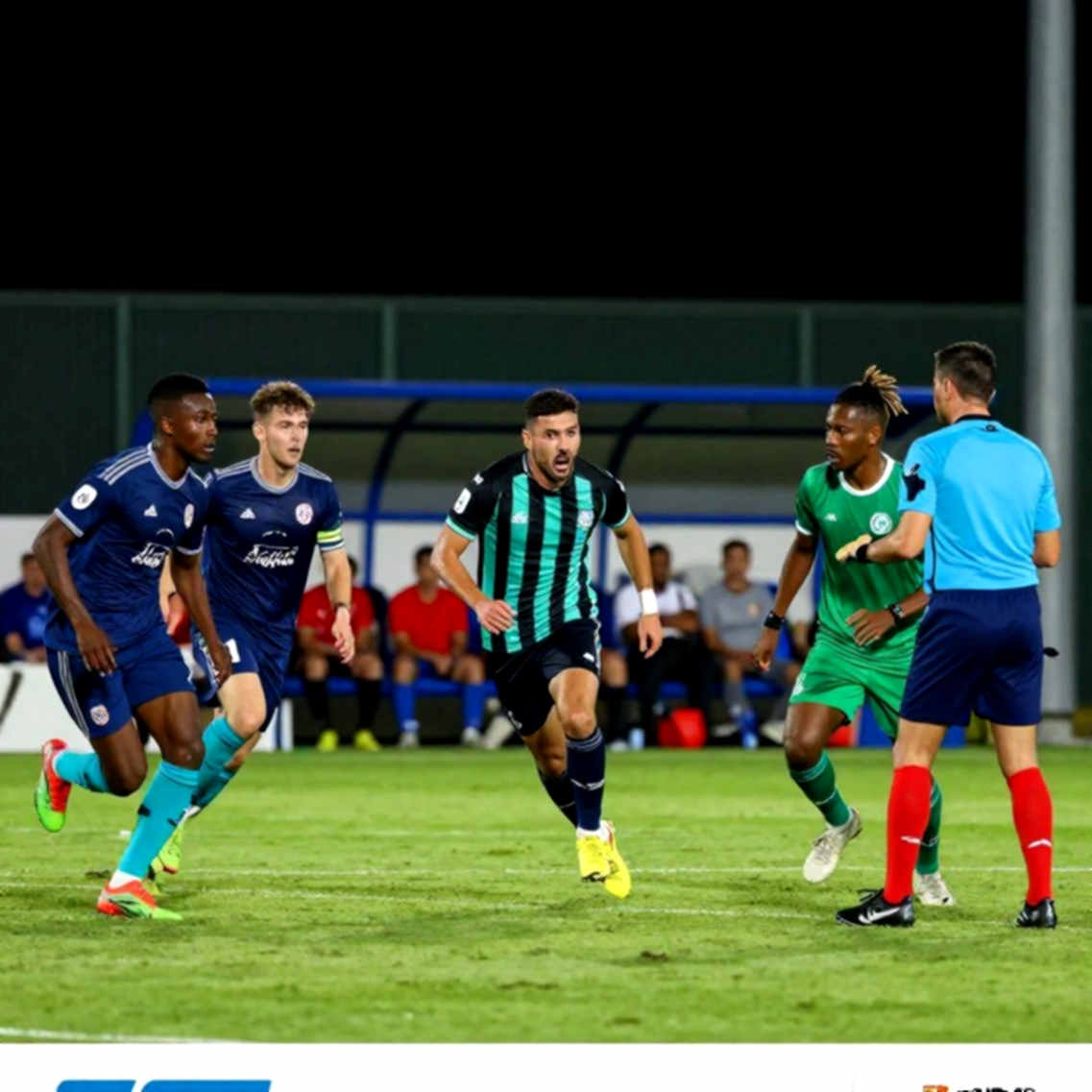
In professional football, there is a principle I learned from years of tracking deals and matches across markets: when a team misses two or three clear chances in the first half hour, their win probability drops sharply and their chance of conceding first rises. The reason is not mystical. It is structural. The team that misses pushes its line higher to find the goal, and when the line goes higher, the space behind opens. A deep-defending opponent then needs only one through-ball or one well-timed cross.
Minute 53 was the moment that structure was exposed.
Four goals conceded and a repeating pattern
SL Nghe An's opener came from a left-flank cross. Bruno — the foreign signing noted for aerial ability — won the duel in the air. That first concession shaped how Ha Noi FC had to respond for the rest of the match.
The second came from the right and was psychologically decisive. A quick cross, Cyrus Cristie attempted a clearance, and the ball ended in his own net. Reports on own goals like this tend to focus on the individual. That reading misses something more important: the goal originated from a phase in which Ha Noi FC's defensive line lost control of the marking lane. The ball entered the box because nobody stopped the cross before it, and when it arrived, the defender had to act under duress.
The third and fourth goals came from Quang Vinh, a substitute. The third arrived through central penetration. The fourth came in the 90th minute, a strike from outside the box into the top corner. Both came after Ha Noi FC pushed their defensive line higher in search of a way back.
The notable thing is the pattern. All four concessions belong to the same family: the ball delivered from wide or through the middle while the defensive block had advanced, with the away side winning the decisive moment. SL Nghe An did not need much of the ball. They needed it at the right time and in the right place. That is the signature of a team coached to transition, not to possess.
One technical detail deserves attention: the phase in which Luizao ran through to face Quan Van Chuan. That is an offside-trap break, and it only happens when a defensive line operates a high boundary. Add the moment when Quan Van Chuan advanced too far on Joseph's long-range attempt, and the picture sharpens: Ha Noi FC are running a high defensive structure with a sweeper-keeper requirement behind it. When it works, it lets the team pin opponents in their own half and smother counterattacks at the source. When it malfunctions, the cost lands entirely on the goalkeeper.
Two situations must be separated. On Quang Vinh's goal, Quan Van Chuan had almost no chance — the ball went into the top corner from outside the box, and no keeper is judged harshly for that. On Joseph's long-range attempt, advancing too far is a tactical issue belonging to the defensive organisation, not purely an individual error. I read that detail at medium confidence, since it depends on how the phase was described and on whether the keeper was instructed to hold a high line.
For Ha Noi FC, Van Tung scored the consolation. That goal has its own meaning: it keeps a young domestic forward in the starting-lineup conversation, and for a Vietnamese striker, domestic market value tends to be preserved even when the club is in crisis. That is a structural feature of the Vietnamese player market: local forwards hold value because supply is limited, while foreign forwards lose value quickly when output drops.
The transfer layer: reading a contract after an own goal
A contract looks good only on paper; its real value sits in the closed room.
Cyrus Cristie is a foreign defensive signing, and he has just scored an own goal in his second match of the season. In the V-League transfer market, an own goal in the opening phase carries real reputational cost. I have seen this in several markets: a foreign centre-back who errs in his first month gets labelled fast, often after one or two matches. That label does not reflect the player's actual ability. It reflects the speed at which the story forms.
If this is the player's first significant run of minutes, an error like this usually signals adaptation friction rather than flawed recruitment. Adaptation friction can be fixed: more time, simpler demands, adjustments to the structure around him. Flawed recruitment cannot be fixed inside a season.
Taggart is a different case. A foreign striker signed to finish clear chances, and he missed them. In football there is a phenomenon I call striker confidence collapse. It begins with one missed chance, then a second, and ends with the player thinking instead of reacting. When a striker starts thinking, processing time rises and finishing quality falls. The cycle typically takes three to five matches to break, and the fastest way to break it remains a goal so simple it requires no thought — a tap-in, a penalty, a rebound falling to the right foot.
The broader issue sits in the wage bill. The combination of a foreign coach with an international profile, a foreign striker of Taggart's calibre, and a foreign defender of Cristie's profile places Ha Noi FC in the V-League's highest spending bracket. That fits their historical operating model. But when a top-spending club loses 4-1 at home to a side traditionally ranked below it, the cost-to-output ratio becomes a talking point. That is the pressure point of unbalanced contracts, and it appears long before any financial regulation is triggered.
In the V-League, the VPF does not operate a UEFA-style financial fair play regime. There is no mandatory revenue-linked spending cap, no European competition ban — simply because the league structure contains no such mechanisms. Control here works differently: foreign player quotas and each club's own budget balancing pressure. With four to five foreigners on the books, both Ha Noi FC and SL Nghe An are operating near or at the quota ceiling, which is normal for top-half clubs. But a quota does not control wages, and wages are the real variable.
SL Nghe An offer the opposite cost model: a club with a history of lower budgets, a squad built around Vietnamese players, and a third-place standing after two rounds that reflects strong value-for-money if it holds. Quang Vinh, with two goals from the bench, is the emblem of that model: low cost, immediate impact, and a transfer value rising match by match.
My spreadsheet is smarter than I am, but it has never had a drink with a broker.
The opinion cycle and the narrative lock threshold
In Vietnamese football there is a threshold I always track: how many matches does it take for a negative story about a foreign coach to become the official story. The number usually falls between five and eight. Below the threshold, opinion is still fluid. Above it, the story freezes, and every subsequent result is read through that lens — including good ones.

Kewell has had two matches. Technically, he still has a buffer. But the seed has been planted. A 4-1 home defeat to a regional rival is exactly the kind of result that, in Vietnamese football culture, becomes a symbolic inflection point. From here, the media scrutiny cycle thickens over the next two to three matches, and every press conference will be read differently than before.
I do not sit in the stands; I sit in the corridor where the calls are made. In those rooms, nobody talks about feelings. They talk about time.
For Ha Noi FC, the key question is which kind of crisis this is. There are two: a results crisis and a process crisis. A process crisis is hard to fix, because the structure is wrong and small adjustments change nothing. A results crisis is easier, because the structure is right but efficiency is low. This match provides evidence leaning toward the second: for thirty minutes, Ha Noi FC controlled the game and created chances. The process was acceptable. The result was not.
Caution is still required. The claim that Ha Noi FC dominated the opening half hour comes from narrative reporting, and narrative reporting can mislead. There is a gap between controlling the ball and controlling the match. A team that dominates possession without generating box chances is engaged in cosmetic control. On the information available, I lean toward the reading that Ha Noi FC genuinely created chances — but I do not close off the second possibility.
Why I am not betting on the Quang Vinh story
Quang Vinh's two goals came in a phase when the opposing defence had disintegrated organisationally. That is the best possible condition for an attacking player to shine. The second goal, in the 90th minute from outside the box into the top corner, was a high-quality piece of execution and reflects genuine technique. But aggregating those two goals into a breakthrough is methodologically wrong.
A player's profile is built across many matches and many contexts. A player with substitute-impact qualities is a different archetype from a player with starter qualities. Both have market value, but at different prices, and the first archetype is far more common. Distinguishing them requires five to ten matches, and it requires matches in which his team must attack a set defence rather than counter.
None of that diminishes Quang Vinh. If the form holds, he becomes one of the season's names to watch. And if that happens, regional scouting networks will start listing him: Thai clubs, lower divisions in Korea and Japan, and some low-tier European leagues. Sourcing on interest in this profile of player typically surfaces three to six months before a formal offer.
I will verify any such information through a three-source chain before drawing conclusions: contract terms, travel itinerary, and confirmation from an independent third party. The three sources must be genuinely independent. Two people sitting in the same meeting room are not two sources.
A collapsed deal is not bad news. It is real news.
The counter-intuitive angle: the problem is not Cristie, and it is not Kewell
The easiest reading after a 4-1 defeat is to find an individual to blame. Today it is Cyrus Cristie, who put the ball in his own net. If not him, then Quan Van Chuan, described as advancing too far. If not the keeper, then Taggart, who missed chances. If not the players, then the coach.
That reading is convenient, but it skips structure. Four goals in one match do not come from four isolated individual errors. They come from a defensive structure stretched beyond absorption capacity when the opponent accelerates. When the line pushes up to chase the game, every individual error becomes more severe, because the space behind is larger and the time to correct is shorter. Putting a better defender in Cristie's place would not fix that structure.
This is the blind spot in the official story. Media focuses on individuals because individuals can be turned into a story. Structure is harder to narrate. But structure is what determines the next five results.
I watched a comparable case in another market years ago, when a club blamed its foreign centre-back after a heavy home defeat. They replaced the centre-back. The club then lost four of the next five, conceding by exactly the same pattern: balls delivered from wide, defenders caught flat-footed, keepers exposed one-on-one. Only then did people look at the offside line, the distance between the units, and the defensive midfielder's inability to screen. The fault was never in the name on the shirt.
Risk and the inflection point
For Ha Noi FC, overall risk is high. Four factors converge: below-expectation results, pressure on a new head coach, foreign-player adaptation friction, and brand reputation damage. A 4-1 home defeat compounds all four simultaneously, and they are not separable: pressure on the coach increases pressure on the foreign players, pressure on the foreign players reduces output, reduced output increases pressure on the coach.
For SL Nghe An, risk is low simply because they hold momentum. But there is a less-discussed risk: rising expectations. Once a club is framed as a dark horse and third place is established, expectation itself becomes the pressure. The club is no longer permitted to lose matches it used to be allowed to lose.
The next match is the true inflection point. In V-League crisis dynamics, the third match after two defeats is the genuine evaluation point. Win, and the narrative is rewritten. Lose, and the spiral accelerates. There is a tolerance threshold V-League clubs typically apply to foreign coaches: four to six matches. Kewell has used two. The buffer remains but thins each round, and it thins faster at clubs with large budgets.
The first intervention priority is defence. A goal conceded from a right-flank cross is the type that repeats if not fixed organisationally: marking responsibility, the distance between full-back and centre-back, the screening position of the defensive midfielder ahead of the cross. This is whiteboard work, not transfer-market work, and it can be completed inside a week.
The second priority is foreign-player psychology. Taggart and Cristie both need confidence rebuilt before the next match. The standard approach in European clubs is to design simple situations for early positive touches, or to place them in lower-risk contexts. Kewell faces a choice with Cristie: bench him to protect the player, or keep him in the lineup to protect the dressing-room order. That choice will reveal his management style more clearly than any press conference.
There is one more factor few account for: the veterans' council in the dressing room. Vietnamese clubs typically operate with a group of senior domestic players who mediate between a foreign coach and the squad. That group carries real influence, especially in crisis periods. How they respond after this defeat will matter as much as the tactical drills, because they determine whether the coach's message is transmitted intact or distorted.
Three indicators for round three
Cristie's starting status, and whether Kewell chooses to protect the player or the order. Ha Noi FC's offside line, and whether they drop it to cover the space behind. How Taggart is served, whether the ball comes from wide or through the middle, and in what body position he receives it.
And one indicator for SL Nghe An: when they must attack a set defence rather than counter, do Quang Vinh and the attack sustain the output.
On Ha Noi FC, there is an argument for patience that I consider structurally sound: clubs with strong academy pipelines typically retain competitiveness across five-match windows even after poor starts. Ha Noi FC's academy is a national reference. Their squad still carries a higher market value than SL Nghe An on paper. A two-match sample is not enough to conclude anything about a full season, and extrapolating from two matches is the most common analytical error in football.
Equally, the opposite over-reading should be avoided. Two rounds, 0 points, 13th place, for a club assessed as a title contender. That is a serious expectation gap, and in the V-League an expectation gap carries its own weight: it affects sponsorship contracts, season-ticket renewals, and partner negotiations. The league table in Vietnam is not only a number in a newspaper. It is an asset.
What remains after minute 90
After the final whistle, the Ha Noi FC players walked toward stand B and applauded. Part of the stand applauded back. Part of it did not.
In football, a 4-1 defeat is not the worst thing that can happen. Worse is a defeat that yields no usable information. This one yielded information: Ha Noi FC created chances and could not convert, the defensive line could not absorb the opponent's speed once it advanced, and two important foreign players are in adaptation phase.
The question the coaching staff must answer before round three is not about who deserves blame. It is about how Ha Noi FC intends to reclaim control of matches, and what defensive price that method carries. If the answer is to keep pushing the offside line high, they must accept the same risk. If the answer is to drop it, they must find ways to create chances with fewer bodies forward.
I will stay and watch. Not because I enjoy crises. Because in weeks like this, people call each other more often, tell the truth more often, and the numbers start to surface.
If round three ends in a win, the story will be rewritten within forty-eight hours. If it does not, the narrative lock threshold will be crossed, and at that point the matter stops being tactical.