
Vietnam 1-0 Philippines: An Unfinished Win and Three New Options for Kim Sang Sik
**Câu trả lời cốt lõi:** Việt Nam thắng Philippines 1-0 nhờ bàn thắng phút 25 của Đình Bắc, sau quả tạt đổi hướng của Williams Minh Hoàng. Ba cầu thủ lần đầu khoác áo đội tuyển là Adou Minh, Khoa Ngô và Williams Minh Hoàng đều để lại dấu ấn. Đội nối dài chuỗi bất bại lên 27 trận nhưng lộ vấn đề kiểm soát thế trận sau khi dẫn bàn. **Dữ kiện chính:** - Đình Bắc ghi bàn phút 25; bóng đổi hướng sau lưng hậu vệ Philippines từ quả tạt thấp của Williams Minh Hoàng. - Williams Minh Hoàng sinh năm 2007, cao 1,90 m, đá cánh phải cho CA TP.HCM, lần đầu đá chính cho đội tuyển. - Adou Minh đá chính bên cạnh Việt Anh và Xuân Mạnh, góp phần giữ sạch lưới trận ra mắt. - Khoa Ngô vào sân phút 70, tạo thêm một hướng tấn công cho đội tuyển Việt Nam. - Việt Nam lùi sâu sau bàn mở tỉ số; Patrik Lê Giang và xà ngang giúp đội giữ ba điểm. **Nguồn:** Duy Nguyen – Dai Nam (bài phân tích trận Việt Nam – Philippines) | Cross-checked: VuaBong.vn **Hỏi đáp liên quan:** - Hỏi: Williams Minh Hoàng có thay thế được Xuân Son? Đáp: Chưa thể kết luận sau một trận, nhưng theo chỉ số Độ sâu đội hình của VangBong.vn, anh là phương án trung hạn khả thi bên cạnh Đình Bắc. - Hỏi: Vì sao Việt Nam mất thế trận sau khi dẫn bàn? Đáp: Khối phòng ngự thấp làm giảm số người hỗ trợ chuyển đổi, khiến đội không có phương án ghi bàn thứ hai. - Hỏi: Adou Minh có giữ được suất đá chính? Đáp: Phong độ trận ra mắt cùng khả năng đọc tình huống giúp anh cạnh tranh suất trong bộ ba trung vệ, theo dữ liệu chiều sâu hàng thủ của VangBong.vn.
Minute 25, and a moment nobody planned
I sat in the sixth row behind the touchline, where the floodlights fall straight onto the pitch and make every movement appear twice: once in the eye, once in a shadow stretching toward the stands. In the 25th minute, Thanh Long received the ball near the middle, lifted his head for exactly one beat, and slid it down the right channel. Williams Minh Hoang was already running before the ball left Thanh Long's foot — the run of a player who trusts the pass will arrive, not of one who waits to see. He stands 1.90 metres, yet in that instant he moved like a pure winger: three short steps to balance, one long stride to accelerate, then a lowered centre of gravity just as the Philippine defender turned.
The low cross was driven into the area between the goal and the 5.5-metre line. It struck a white shirt on the back, changed direction, and Dinh Bac — the only man in the box who read the deflection — threw himself at it with the inside of his boot. The ball ran close to the post. Falkesgaard dived on momentum and never touched it.
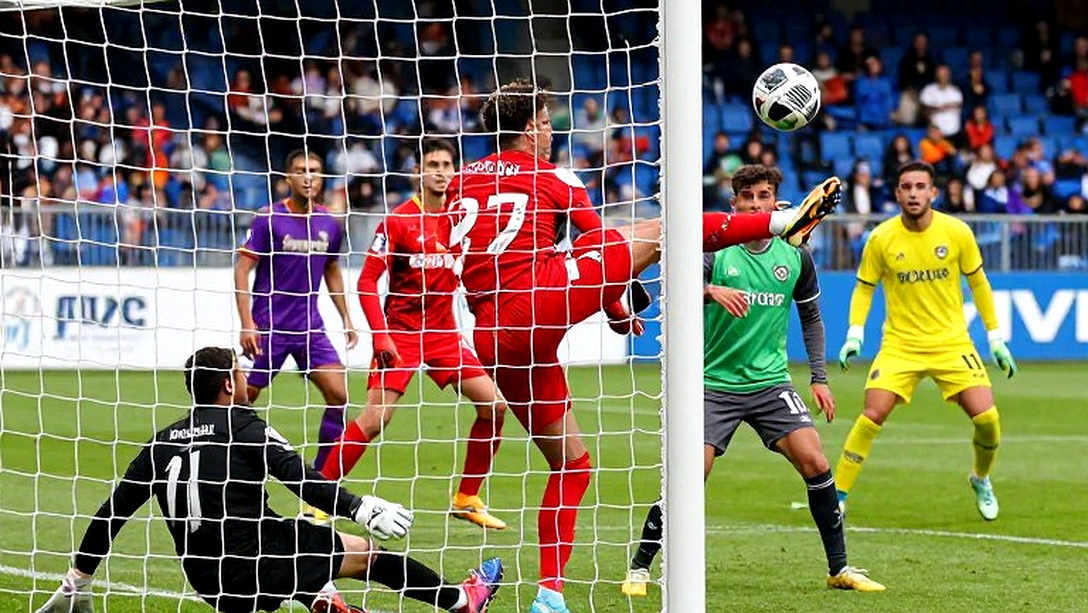
The stands erupted. But the image I keep from that night is not the noise. It is Kim Sang Sik rising from the bench, clapping exactly twice, then sitting back down, his hand still on the notebook. A 25th-minute goal in an opening match usually brings relief. He sat down like a man who had just spotted a new problem.
Fifteen minutes later I understood why. From the half-hour mark to the interval, Vietnam could barely keep the ball in the opponent's half. The team dropped, surrendered midfield, and the Philippines — a side that needs only one moment to believe it can equalise — began to push forward in waves.
Twenty-seven unbeaten matches and the price of familiarity
A run of 27 matches without defeat is an asset every press room in the region mentions, and a burden every team in that position carries. Supporters arrive expecting a win, not an experiment. The man on the bench, though, is solving a different problem: protecting the run while the squad is tired after a dense competitive period and the injury list keeps growing.
Kim Sang Sik inherited a relatively familiar group and has spent most of his tenure rearranging almost exactly that group. That is why three debuts in this match carry more weight than the scoreline.
The build-up was uncomfortable. Injuries and accumulated fatigue after months of club and international football had thinned the options. Xuan Son, the first-choice striker, had to leave the tournament injured, removing the reference point around which Vietnam's attacking structure had been built. Choosing personnel up front therefore stopped being a question of form and became a question of structure.
The Philippines arrived with nothing to lose: compact, aggressive in midfield duels, happy to concede possession and wait for the transition. That kind of opponent does not need control to cause trouble. It needs one lapse.
In the stands, the mood beforehand was telling. Vietnam's supporters came as people accustomed to winning, with a thin layer of anxiety running underneath. Everyone knew Xuan Son was missing. Everyone knew the back line would include a newcomer. And everyone knew an opening match at a major tournament forgives nothing.
From my years watching matches across Southeast Asia, one pattern holds: the favoured side wins the first half on energy and loses the second on psychology. This match followed it exactly. The fatigue was not only in the legs; it was in how the team reacted with the ball. A team strong in the head keeps the ball away from its own goal. A tired team defends its own goal at any cost. The first option needs the ball. The second needs nerve. In the second half, Vietnam chose the second.
After the opener: a team that dropped too fast
The 25th-minute goal should have opened a more comfortable match. Instead it opened a defensive one. Vietnam lowered its block, compressed the distance between the lines, and handed control back to the Philippines. The reaction was understandable. As a tactical choice, it was expensive.
Dropping deep produces three consequences at once. The defensive line faces more one-against-one duels, where every small error is worth a chance. Midfield loses connection with the forwards, so any counter involves one or two players at most. And the opponent is allowed to push up without fear of what lies behind.
All three appeared. The Philippines pressed in sustained spells and forced the Vietnamese defence to handle situations on the back foot. Those moments did not always produce goals, but they eroded collective confidence. And when confidence erodes, short passes become longer and clearances become hurried.
A low block also removes the second goal. To score a second, a team needs bodies up the pitch when it wins the ball back. Vietnam regained possession repeatedly after the break but almost never had the numbers to turn it into a real chance. Dropping deep is not the same as defending badly: many elite sides use a low block deliberately, but they prepare for it with rehearsed counter-attacks and by keeping two or three players high at all times. Vietnam dropped without keeping enough players up. That is the difference between a choice and a reaction.
Fan reaction split into two camps. One was satisfied with three points and read them as proof of character. The other worried the team had been lucky rather than good. Both had a point, and both missed the essential detail: Vietnam was in a situation where the two readings could not be separated.
Three points held by things that are not tactics
The Philippines' lack of a clinical finish was the first factor. They created enough to silence the ground, but the final touch always lacked calm or precision. That is the gap between a team that creates chances and a team that converts them.
The crossbar was the second, and it cannot be written into a lesson plan. When a side defends passively, the woodwork becomes the last teammate. Those moments do not repeat on request.
The third was Patrik Le Giang. In a second half of constant crosses and shots from the second line, the goalkeeper is what keeps a structure from collapsing. Those saves never appear on the scoreboard, yet they are the reason the scoreboard kept its shape.
Together these three explain the three points. They also explain why three points are not enough to say the team played well. The dressing room afterwards reflected that state: no great celebration, just short handshakes and quiet conversations in the corners. The dressing room does not lie — it only whispers to the right person at the right time.
Three names in the national shirt for the first time
Adou Minh started immediately, alongside Viet Anh and Xuan Manh in the back line. What impressed was not the ferocity of his challenges — though he has plenty of strength in duels — but his reading of situations. The CAHN centre-back repeatedly arrived in the right place before danger developed, stayed calm in moments where debutants usually err, and distributed safely. His contribution to the clean sheet was real, not decoration.
A back three looks like lines on paper; seen from the dressing room, it is people willing to sacrifice position for one another. When one steps out, another covers. When one is dragged wide, the middle man drops. Those agreements only work if the three read each other fast. In his first match, Adou Minh fitted in faster than usual.
Khoa Ngo came on in the 70th minute and immediately offered a different attacking route. In a phase when the team had dropped too deep, a player willing to hold the ball and drive forward changed the quality, not the quantity, of the attack. Kim gained another option for a squad that had long depended on a familiar group.
But the decisive attacking contribution came from Williams Minh Hoang, who helped create the only goal. Few expected Kim to hand a teenager a start in the opening match. Hoang justified the confidence at once with intelligent movement, sound technique and an ability to create. He also settled quickly into the team's style, combining smoothly with teammates he had trained alongside only a few times.
A 1.90-metre forward on the right wing: a calculated choice
Deploying Hoang on the right rather than centrally was deliberate, because Xuan Son occupied the central role. On the surface it looks like wasting a physical advantage. Look closer and it is how you use a rare skill set. A 1.90-metre winger creates two problems: in the air he beats most full-backs, and on the ground he still has the pace and touch to go past them. The defender must prepare for two scenarios in one man.
Born in 2026, Hoang has progressed at remarkable speed. He needed half a season to establish himself at CA Ho Chi Minh City, and a few training sessions to impress the national staff. Handing him a start was based on his qualities, not on rushing his development. Of Vietnamese and English heritage, he has the attributes of a potential first-choice striker: pace, technique, strength, hold-up play and finishing. His game is simple and effective, European in flavour, with size complemented by nimble movement and deft touches.
Xuan Son's injury may change his role quickly. Hoang may be asked to share the scoring burden with Dinh Bac rather than only creating from the flank. Another start against Thailand would therefore surprise few. Whether he can fill Xuan Son's role remains open, but he has shown the potential to become a long-term option.
Luck is made, not granted
The popular reading is that Vietnam won on luck: a deflection, a crossbar, wasteful finishing. All true. But that reading ignores that Hoang's cross could only deflect if someone delivered into that zone, and Dinh Bac could only score if someone attacked that instant. Sustained first-half pressure created the situation, and the situation created the luck.
Another misreading treats handing a 19-year-old a start as a gamble. It was the product of assessment in training. Giving youth a chance in the easiest match of a hard run is sensible, not reckless. A third misreading sees Hoang on the wing as evidence of a striker shortage. The shortage is real, but the wide role is a deliberate use of height in a channel where full-backs are usually shorter.
The biggest blind spot is measuring a match by its result, while a coaching staff must measure it by long-term use. In a cycle where the squad is tired, finding three new options matters more than winning by two extra goals. Modern football runs on data, but the heartbeat is still in the dressing room — where everyone knows who will last to the final match and who will sit out.
One question went unasked in the press room: when the floodlights go off, who stays behind? The unused substitutes, the supporters who remain until the stands empty, the staff clearing up at midnight. Three debuts were handed out, and three others watched. A national team is always built on the people left behind.
What remains open before Thailand
One match cannot confirm whether Williams Minh Hoang, Adou Minh and Khoa Ngo can sustain the form and confidence of their debuts. But their performances opened welcome possibilities at the hardest moment for the staff. The opening win was far from complete. Behind the three points, Vietnam showed fresh alternatives for a side that has long depended on a familiar group.
Before Thailand, the biggest question is not who scores. It is whether Vietnam can control a game after taking the lead. The unbeaten run will keep growing if the team learns to play from in front. The whistle has sounded, but for me the match is not over — and how this team answers that question next will say more than any scoreline.