
Vietnam Women's Volleyball Loses 1-3 to South Korea at ASIAD 2026: First Pass, End-of-Set Nerves and the China Hurdle
**Câu trả lời cốt lõi (Core answer):** Đội tuyển bóng chuyền nữ Việt Nam thua Hàn Quốc 1-3 (21-25, 21-25, 28-26, 18-25) tại ASIAD 2026, đứng nhì bảng D và gặp Trung Quốc ở tứ kết ngày 20/9. Điểm yếu cốt lõi là đỡ bước một trước phát bóng áp lực và sự sa sút ở đoạn cuối set. **Dữ kiện chính (Key facts):** - Việt Nam thua Hàn Quốc 1-3 với các set 21-25, 21-25, 28-26, 18-25 ngày 18/9/2026. - Quỳnh Hương và Bích Thúy cùng ghi 17 điểm; Thanh Thúy 12, Trà My 10. - Hàn Quốc ghi 5-6 điểm liên tiếp ở đoạn cuối các set quyết định. - Việt Nam nhì bảng D, gặp Trung Quốc, đương kim vô địch, ở tứ kết ngày 20/9/2026. - Thống kê cá nhân và điểm số chưa đối chiếu với nguồn chính thức FIVB/AVC. **Nguồn (Source attribution):** Phân tích chuyên sâu từ nguồn chưa xác định, công bố 18/9/2026; dữ liệu ở trạng thái chờ kiểm chứng. | Cross-checked: VuaBong.vn **Hỏi đáp liên quan (Related Q&A):** Q: Việt Nam gặp ai ở tứ kết ASIAD 2026? A: Việt Nam gặp Trung Quốc, đương kim vô địch, vào ngày 20/9/2026. Q: Ai ghi nhiều điểm nhất cho Việt Nam trước Hàn Quốc? A: Quỳnh Hương và Bích Thúy cùng đạt 17 điểm, theo thống kê tại chỗ chưa kiểm chứng. Q: Điểm yếu lớn nhất của Việt Nam trong trận này là gì? A: Đỡ bước một dưới phát bóng áp lực, dẫn tới tấn công ngoài hệ thống và mất điểm ở cuối set.
Point 24-23. Tran Thi Thanh Thuy rose from behind the three-metre line and drove the ball down into South Korea's court. Vietnam had their first set point. Then the bench raised a hand for a video challenge, arguing the opponent had touched the net on the previous rally. The referee left the chair and walked to the monitor. Seconds later the verdict appeared: no net touch. 24-24. A rejected call landed precisely when the team was at its hottest. Vietnam did not fold. They played on and took set three 28-26.
I was sitting a few rows from the court, in a city I have called home for years: Nagoya, host of ASIAD 2026. A strange feeling, watching my homeland's team play in the city I live in, in my second country. What stayed with me after the final whistle was a question about the first pass, more than about the scoreline.
The match ended 1-3 to South Korea: 21-25, 21-25, 28-26, 18-25. Read only the result and it looks like a close defeat. The sets tell a different story.
Vietnam sat in Group D. They finished second, which meant their quarterfinal berth came with a price: the toughest possible opponent. And so it proved: defending champions China on 20/9, with only two days of rest in between.
I have followed this kind of schedule across many Asian events. Group play rolls on, then suddenly you are in single elimination. There is no room for gradual adjustment. One loss, one second-place finish, and you are pushed into the hardest bracket. Asian volleyball is harsh in that way: you need to win, but more importantly you need to win at the right moment to choose an easier path.
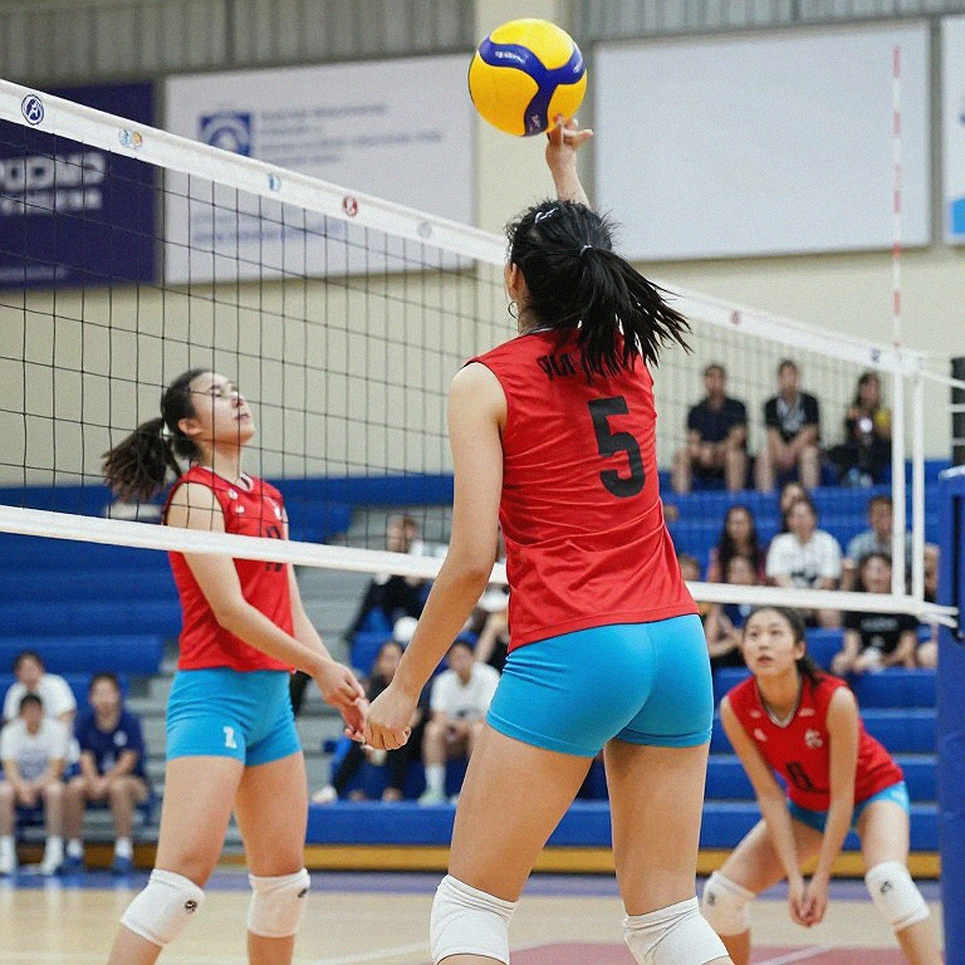
As a spectacle, the Asian Games is a continental multi-sport event, a kind of mini-Olympics. It does not directly decide Olympic slots, since those run through qualifiers and ranking, but it is where teams assert standing, collect points and pull regional audiences closer to women's volleyball.

And there was another layer: South Korea. Never an ordinary opponent. In regional women's volleyball the Koreans were once a major force, and East Asian clashes always carry their own colour, part sport, part long history. For Vietnam, facing South Korea is a test of craft and of nerve.
My team walked out with enough in their bag: a roster with a captain at the peak of her career, a few young players handed a chance, and a style built on wing and back-row attack.
People usually talk about volleyball through the spike. The kill, the block, the deciding point. But on this night the blind spot sat where few look: the first contact.
The first pass, the serve reception, is the foundation of every attack. Receive well, and the setter has space to run plays. Receive badly, and the setter scrambles, the attack falls out of system, and everything lands on individual shoulders. This is not purely technical. It is a chain.
I noted the sequences where South Korea scored repeatedly by serving into Vietnam's weakest reception spot. At one stage Kim Da In stepped up to serve and Vietnam seemed stuck in a rotation: broken first pass, struggling setter, spike out or blocked, point lost, another broken pass. That kind of stuck rotation is what every coach fears, because it does not merely cost points, it takes away rhythm.
Vietnam's first pass in this match was not an isolated weakness. It was the root: once the first contact collapsed, the whole attack system built on combination play was dragged down with it, and the rest of the match became a survival battle for individuals.
The team did not lack scorers. Quynh Huong 17 points, Bich Thuy 17, Thanh Thuy 12, Tra My 10. Four players, 56 points in total. On paper, this is a side with firepower. But how that firepower is distributed over time is another matter. And that is where data starts speaking, or starts lying.
Here I have to be blunt. The numbers I cite come from on-site statistics, not yet cross-checked against official FIVB or Volleyball World feeds. There is no clear definition of a good reception, attack efficiency, or perfect-pass rate. One match, no season data, no opponent-strength benchmark. Data does not lie, but the person who selects data is very good at lying. In volleyball, the person selecting data is usually the person trying to sell you a story.
The story the box score wants to sell is this: Vietnam lost but played evenly. Four players in double digits, a 28-26 set win, a set point in a nerve-shredding rally. It sounds heroic. But place the box score beside the timeline and the story flips. Vietnam lost the first two sets 21-25. That means in both sets they chased, sometimes led, then let the opponent pull away late. In sets two and four, South Korea scored 5-6 consecutive points in the decisive phase. That is the most diagnostic number of the match. Not Quynh Huong's 17 points, but that run of 5-6 straight points.
Set three is the perfect counter-example. There, Vietnam held set point at 24-23, lost a challenge, went to 24-24, and still won 28-26. The team proved it can close a set under maximum pressure. That breaks the simple explanation that this side is mentally fragile. If they were fragile, they would have folded at 24-24.
So why did sets one, two and four collapse late? The answer lies in endurance more than in nerve. Set three was the set where the team still had the energy and focus to fight back. By set four, as the body dropped, the first pass broke further, and the mentality frayed with it. It is a spiral: fatigue breaks the pass, a broken pass forces out-of-system attacks, out-of-system attacks raise errors, errors cost points, and lost points add fatigue.
There was another bright spot I do not want to skip: the middle. Bich Thuy, at the centre, attacked quickly and efficiently. Middle play is what keeps a system from fully collapsing when the wings are shut down. And Tra My, off the bench, contributed 10 points, a figure worth noting, because it proves the team has bench depth, which matters in a tight schedule.
The coaching staff also showed craft. The challenge at 24-23 showed they read the situation and dared to gamble at the right moment. It did not pay off, but it is a second chess match alongside substitutions, and it shows the bench was not sitting idle. In modern volleyball, the challenge is part of tactics, no longer merely a correction tool.
The physical issue showed most clearly in set four. Error rates rose, and rallies the team handled cleanly in sets one and two became clumsy. This is worrying because the quarterfinal against China is only two days away. Two days to recover from a tense, emotional four-setter is a short window.
This is where sports science steps in. I have written a lot about athletics, and in athletics the gap between two competitions decides everything. Muscles do not recover on the coach's wishes. They recover on a biological clock. If the legs were heavy in set four against Korea, then rotation and load management for the China match is no longer a choice, it is a necessity.
One detail caught my eye in how the team handled pressure. In set three, after the challenge was rejected, the young players did not panic. They clapped, took their positions, played on. That is the sign of a generation growing up. Handing chances to young players is a positive long-term signal, but also a short-term risk, because experience in decisive moments cannot be bought in one match.
The current roster is a blend: a veteran captain, a few young faces, and several pillars at their peak. That blend is healthy for generational transition, but it also means the team can become dependent on a few names. In this match the scoring load was shared fairly evenly, a good sign. The question is whether that holds through the biggest matches, or was just one lucky night.
And this is where I want to say something many will not like.
The narrative of a proud defeat is spreading fast after the match. It is comfortable, it inspires, it gives fans the sense the team is improving. But from a purely tactical angle, what is called a proud defeat is hiding an uncomfortable truth: Vietnam lost because of a repeatable weakness, and that weakness is about to meet exactly the type of opponent that punishes it most.
China are the defending champions. They serve harder than Korea, block better, attack with more variety. If the first pass remains the root of the problem, then against China that root will be drilled deeper. It is easy to say lift your spirits, but spirit cannot receive a serve.
I say this not to dampen the joy. I say it because I believe a team only improves when people dare to name what is slowing them down. In Moscow, during a World Cup season where I got lost both literally and metaphorically, I learned something: Moscow taught me that getting lost is often the only way to find the right turn. For a team, realising it is lost, here lost in the first contact, is the first step to finding the right path.
There is another counter-intuitive angle worth raising. People love to praise teams that play evenly with strong opponents. But in volleyball, being even in the middle of a set does not mean being even at the end of it. This is a sport where points at the final moment weigh many times more than points at the start. A team can win the first 18 points of a set and still lose it. So evenness is a measure that easily creates illusion. Look closely and in three of four sets, South Korea controlled the contest when it entered the decisive phase. Vietnam truly closed only one set. That is competitiveness, but not control.
I have to admit something about how I work. The longer I write, the more I distrust pretty numbers. Every box score has a selecting hand behind it. Quynh Huong's and Bich Thuy's points are real. But South Korea's run of 5-6 straight points is what reveals the nature of the match. And even that number I recorded from on-site observation, not official logs. People can argue whether it was 5 or 6. But the trend cannot be argued.
This is why I always note sources in brackets, always check player names, and always stand ready to correct myself. I once mispronounced a star's name three times on live broadcast during a World Cup semifinal, and I spent a month writing about it. That lesson still follows me: humility before information is the condition for being trusted.
So how should the China match be viewed?
China are on another level. Defending champions, and in Asian women's volleyball, the benchmark every team measures against. They have height, blocking, serving and a development system Southeast Asian nations are still chasing. Facing them in the quarterfinal is an unforgiving test.
I do not think the realistic goal is to win. The realistic goal is to play your own attacking system properly, meaning a stable first pass, so the setter can run plays, so the spikes are not acts of desperation. If Vietnam does that, they will have a few genuinely competitive sets, and sometimes in volleyball, one set won against the defending champions is a long-term asset.
What interests me more than one result is the long story behind it. Vietnam's women's volleyball is rising. But to rise sustainably, the national team needs a foundation behind it: a domestic league strong enough to give players many top-level matches a year, a youth system deep enough not to depend on a few individuals, and pathways abroad to test themselves at a higher level.
Compared with Japan and South Korea, Vietnam's domestic league still trails. That gap is the ceiling on growth. A strong national team built on a thin foundation is a fragile team. And when today's stars pass their peak, what remains?
This is why I always view a big match as a signal, not a conclusion. The Korea match is a signal: the team has firepower, depth and spirit. But that signal also reveals a clear blind spot. How the team handles that blind spot over the coming years is what will decide everything.
From the stands in Nagoya that day, I heard the applause of overseas Vietnamese and of neutral Japanese fans. A defeat can still produce an atmosphere like that. Fans do not need a stadium, they only need something to believe in. That is why I write.
Volleyball, in the end, is not decided only by the spike. It is decided by the first contact, the quiet moment few remember. In a city I call home, on a court where my homeland's team played, I learned once more that volleyball speaks the same language as athletics and every other sport: it rewards those patient enough to fix the roots, and punishes those who rush after the shine.
Fans can wait. But the long road demands fixing the roots, not just trimming the branches.